Showing posts with label #springwatch. Show all posts

Tuesday, 21 May 2019

Pied Crow Tour of Britain reaches Broadstairs

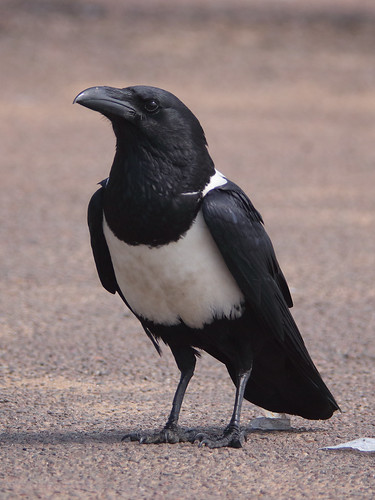
Pied Crow (Corvus albus)

When I first heard about a Pied Crow being sighted in East Kent I assumed it was some kind of birders' in-joke. After all, what is a "pied crow" if not the definition of a magpie? Also, there's no such bird mentioned in either the Collins Guide or the British Birds (WILDguides) book, not even in the once-in-a-lifetime lists of obscurities tucked away at the back.

But it turns out the Pied Crow is definitely not a magpie, as I found out when I caught up with it on Broadstairs jetty last Saturday (18 May). Even from a distance the white "vest" was obvious, and the bird itself is bigger than a conventional carrion crow (though not as large as a raven).
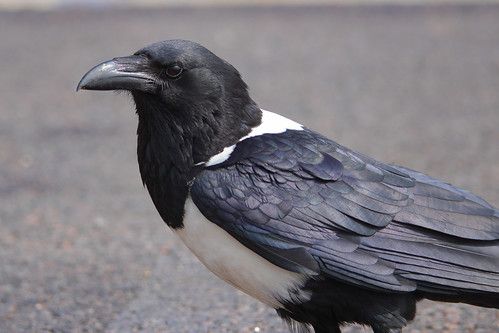
Pied Crow (Corvus albus)

So is this smartly-dressed corvid (normally a resident of sub-Saharan Africa) a genuine wild specimen or an escapee? I won't get into the speculation on where it might have come from as there's already plenty of that online by people far more knowledgeable than me on such matters, but I will refer you to this excellent article by Sam Viles on BirdGuides. Will it fly (or hitch a ride) across the Channel or will it continue its tour of Britain's seaside resorts? Like the outcome of B****t, your guess is as good as mine.

Next stop France?

As I think I've stated before on this blog, I don't keep a count of the birds I've seen and photographed (although I do keep an index), so it makes little difference to me whether or not it gets accepted onto an official list by the powers-that-be. But I do know that this unusual and striking bird has traveled a long way to get to where I live, so I'm glad I got to see it.

See also:
Birdguides: Pied Crow
Birdforum Opus: Pied Crow

Friday, 8 April 2016

Oare Marshes

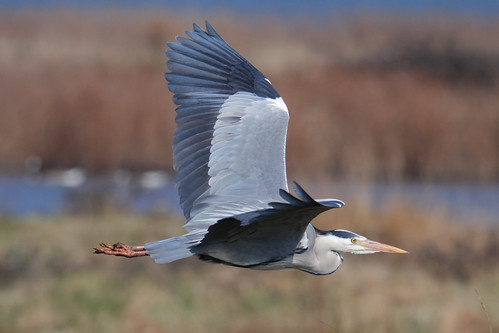
Grey Heron in Flight

Alternative Title: A long overdue write-up of a long overdue trip 


The Oare Marshes KWT reserve is a bit further afield than my usual haunts, but I fancied a change of scene and so I took advantage of a warm March day to pay my first visit. The walk from Faversham station is actually quite pleasant if you don't mind a bit of a trek, but it seems a lot of the visiting photographers/birders park along the road that runs through the middle of the reserve, get the required photos/ticks, and then drive off to the next location - sometimes without even leaving their cars! Such is the accelerated and competitive nature of modern life, but you'll forgive me if I prefer a more sedate approach.

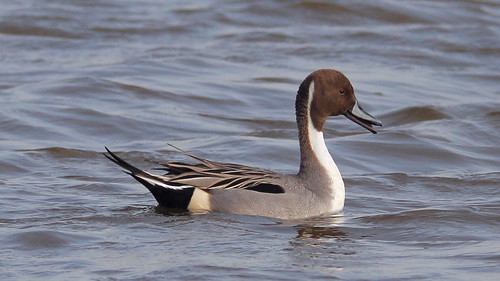
Pintail (Anas acuta)

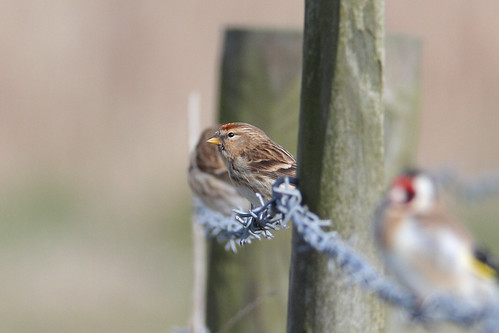
The reserve is quite contained; you can walk all the way around it a lot quicker than, say, the extended Grove Ferry/Stodmarsh circuit. I must have walked round it one-and-a-half times while I was there - perhaps more if you factor in the distance I covered trailing after the mixed flock of Goldfinches and Lesser Redpolls:

Lesser Redpolls (Carduelis cabaret)

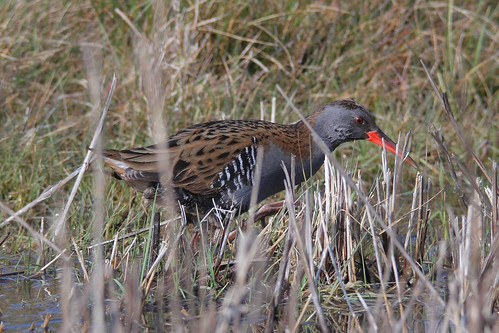
For those who wish to give their feet a rest, there are three hides on the reserve. On the day I visited they were all in pretty good condition. They also happened to be completely empty, which is not entirely surprising given that a) there were no birds anywhere near them, and b) they were facing directly into the wind - which made for an eye-watering experience. Fortunately most of the highlight species could be seen quite easily from the viewing points along the road, including this uncharacteristically obliging Water Rail:

Water Rail (Rallus aquaticus)

I don't generally keep lists, but on this occasion I jotted down all the birds I'd seen and heard (written that same evening, from memory). I counted forty-one different species, which were - for those who are interested in such things - as follows: Avocet, Bearded Tit, Blackbird, Black-headed Gull, Black-tailed Godwit, Blue Tit, Canada Goose, Carrion Crow, Cetti's Warbler, Coot, Curlew, Dunnock, Goldfinch, Green Woodpecker, Grey Heron, Greylag Goose, Herring Gull, Lesser Redpoll, Little Egret, Little Grebe, Magpie, Mallard, Marsh Harrier, Meadow Pipit, Moorhen, Mute Swan, Oystercatcher, Peregrine Falcon, Pintail, Redshank, Reed Bunting, Robin, Shelduck, Shoveler, Skylark, Snipe, Starling, Teal, Tufted Duck, Water Rail, and Wood Pigeon.

Not bad for a first visit, though having read subsequent reports it's possible that I may have walked past a Little Owl without spotting it. Sounds like a good excuse for a return trip...


See also:
More of my photos from Oare Marshes
Oare Marshes (Kent Wildlife Trust)
Oare Marshes Latest Sightings (KOS)

Friday, 31 May 2013

Have I Got Newts For You

This time last year I'd never knowingly seen a newt outside of a book or a TV programme. Then, in a pond not far from where I work, I spotted several of these:

Great Crested Newt larva

This, I subsequently found out, is the larval form of the Great Crested Newt, the largest - and most endangered - of the three species of newt native to Britain. With its rough, granular skin, scythe-like tail and impressive jagged crest, the adult male Great Crested Newt is the closest you'll come to seeing a dragon in the English countryside, so - as you can imagine - I was rather keen to get a photo of one.

Like a lot of creatures, Great Crested Newts look at their best during the breeding season (i.e. now), but trying to photograph them is easier said than done. I quickly found out that they rarely come up to the surface, and when they do they typically dive straight back down again before you can get the camera anywhere near them. In the meantime, I had to console myself with getting pictures of the smaller Smooth (Common) Newt:

Smooth Newt

...and the equally diminutive Palmate Newt, with its distinctive webbed hind feet and tail filament:

Palmate Newt (Lissotriton helveticus)

But still no photos of a Great Crested Newt.

Then, just when it seemed that the pond would be covered with lily-pads before I even got so much as a single shot, my Great Crested Nemeses finally decided to cooperate:

Great Crested Newt (Triturus cristatus)

Okay, so they're not the cleanest photos I've ever taken, but shooting subjects in a pond (as opposed to a brightly-lit aquarium) is never easy at the best of times, and you can only do your best with what you've got. If you're trying it yourself I recommend a fast, close-focusing lens in the 100 - 300 mm range ... and a great deal of patience.

P.S. I apologise for the terrible pun headlining this post, but it was either that or the even more lame "Goodness Gracious, Great Crested Newts!"


See also:
More of my newt photos on Flickr
Great Crested Newt Conservation Handbook (froglife.org)


Saturday, 2 June 2012

The Travels of Y114264

Pied/White Wagtail 

On 23 November 2011 a first-year female Pied/White Wagtail was caught and ringed at Wicken Fen, Cambridgeshire. 173 days later it showed up at Stone Bay, Broadstairs (a full 132 km from the ringing site), where yours truly happened to have his camera with him. As it foraged on the sand in front of the beach huts I was able to get close enough to photograph some of the detail on the ring:

Wagtail ring (blow-ups) 

As you can see, I was only able to get a partial reading of the characters - Y?426? and "NH MUS LONDON" (clearly, the Natural History museum). Fortunately, this was enough information for the BTO to identify it as Y114264. These types of small numbered rings are usually only reported when the bird is found dead or caught by another ringer; typically, reports are more likely to come from colour-ringed schemes, as was the case with this Waxwing I photographed in December 2010.

So why go to all this effort to trap and ring birds (the majority of which are never seen again)? To quote the BTO:

"Ringing birds is essential if we are to learn about how long they live and when and where they move, questions that are vital for bird conservation. Placing a lightweight, uniquely numbered, metal ring around a bird’s leg provides a reliable and harmless method of identifying birds as individuals.
Although we have been ringing birds in Britain and Ireland for over 100 years, we are still discovering new facts about migration routes and wintering areas. However, the main focus of the Ringing Scheme today is monitoring bird populations. Ringing allows us to study how many young birds leave the nest and survive to become adults, as well as how many adults survive the stresses of breeding, migration and severe weather. Changes in survival rates and other aspects of birds’ biology help us to understand the causes of population declines." 
Source: http://www.bto.org/volunteer-surveys/ringing/about

There is, of course, also the personal satisfaction derived from transforming what would otherwise have been an anonymous member of its species into a recognisable individual with its own story to tell.

So, if you find or photograph a ringed bird you can report it to Euring Web Recoveries and the body responsible for that ringing scheme will send you a report detailing the bird's history.

See also:
Euring.org
BTO Bird Ringing Blog
Summary of all Ringing Recoveries for Pied/White Wagtail (Motacilla alba)
BTO Birdfacts: Pied Wagtail

Monday, 7 May 2012

2.5-Dimensional Slideshow

Those of you who visit my Flickr page may have already seen this, but a lot of work went into it, so I make no apologies for airing it again. All of the birds in this presentation were photographed in East Kent, and all of them were wild (even the Kestrel):


I say a lot of work went into it, but how much? Well, to create the pseudo-3D effect, you first have to isolate the foreground element (the bird) from the background. This is done in Photoshop by duplicating the background layer, adding a mask and painting it so only the bird is revealed. You then have to remove the bird from the background layer by careful application of the clone brush (or the Content-Aware Fill tool if you're lucky enough to own a newer version of PS). The next step is to import these layers into Adobe After Effects, place a suitable distance (z-space) between the foreground and background elements, create a virtual camera to track in (or out), choose positions for your start and end keyframes, decide on the length of time it takes the camera to move between these keyframes, and render the animation.

...and that's just one shot completed; now you have to do the same again for all the other images.

Here's a behind-the-scenes screenshot showing a typical camera move being set up in After Effects:


There's a lot of trial and error involved in getting it just right, but the process does become simpler once you've worked through a couple of images.

While synching all the shots to the cues in the soundtrack*, I found I had more clips than I needed, so here - for those who are interested in extras - are the "Deleted Scenes":


If I haven't put you off and you want to try making your own 2.5D slideshow, a step-by-step PDF tutorial can be downloaded from this page:
http://www.daynw.com/3d-for-2d-moving-image-slideshow-effect-tutorial/
Note: Even making just an 85-second video was very time-consuming; this is not the sort of project you can knock off in a single afternoon.

Incidentally, if anyone knows where I might find a tutorial that explains how to replicate all the After Effects steps in Blender, I'd very much appreciate it if you left a link in the comments.

*The music for the slideshow is of course Aquarium from Saint-SaĆ«ns's Le carnaval des animaux, used to such memorable effect in Terrence Malick's 1978 film Days of Heaven.