Showing posts with label kent. Show all posts

Tuesday, 28 May 2019

Into the Whirlpool

Ask someone to draw you a galaxy and chances are they'll come back with a spiral shape. Even a small telescope will show you plenty of galaxies (if you know where to look), but how large a scope do you need to see those dramatic spirals? Edge-on galaxies like M82 and NGC 4565 show lots of detail in modest-sized scopes because their light is concentrated into a smaller area, but the majority of face-on galaxies have such a low surface brightness that the slightest haze or encroaching light pollution can render their spiral arms invisible.

There are a few notable exceptions however, and for northern hemisphere observers, the consensus seems to be that Messier 51 (commonly known as the Whirlpool Galaxy) is the best of the bunch. It resides some 25 million light-years away in the constellation of Canes Venatici (the Hunting Dogs), and can be found high overhead on spring evenings near the tail of the Great Bear (Ursa Major).

Here's a photo I took (actually forty-three 90-second exposures, stacked together) in March, showing the spiral very clearly:


M51 & NGC 5195, 28 Mar 2019; Canon EOS 80D + Tele Vue-60 + Vixen Super Polaris

For a larger crop, see the version on my Flickr page.

Sixty-five minutes' worth of sensor data is one thing, but how much of that detail can you actually see with your own eyes? M51 and its interacting companion NGC 5195 are easy enough to spot through even a small scope, but it wasn't until I got the 10-inch reflector that I was able to see them as more than a pair of faint fuzzy blobs. Even then, the detail was elusive, with the dark spaces between the Whirlpool's arms often more apparent than the arms themselves.

My sketching skills are very rusty so it took me three attempts before I got something I was happy with, but here's an approximation of what M51 looks like through a medium-sized scope on a good night:


For this I used the 10-inch Orion XT10 and a Tele Vue Nagler 9mm eyepiece, giving a magnification of 133x.

Depending on the quality of your night sky, you may be able to see M51's spiral with a smaller telescope. I was never able to make it out with my 4-inch refractor (although the two galaxies themselves were obvious), and even with the XT10 I can't always see it, as demonstrated by these excerpts from my observing notes:

19 May 2018 (first night out with the new scope; sky a little hazy)
Not well placed (wrong side of meridian), but both galaxies showed bright cores. Strong hint of spiral arm structure, and a star superimposed over the face of the galaxy (not a supernova!).
10 February 2019 (cold, but not freezing; sky transparency improved considerably once the crescent moon got out of the way)
In a night of highlights, M51 was the undoubted stand-out. After staring at it for a couple of minutes I suddenly realised I could see the spiral arms quite clearly, defined by the dark space separating them. One arm curling out from core region around a foreground star. A magnificent sight at 133x, even though it was still some way from the zenith. With averted vision it started to look like a ghostly monochrome photo.
31 March 2019 (slightly chilly, windy with occasional strong gusts; transparency good, but not up to the standard set on 10 Feb)
Tonight M51 and NGC 5195 had an almost ghostly aspect about them; the spiral arms seemed to fade in and out of existence independently of averted vision. The view wasn’t substantially improved at 240x, other than highlighting some of the brighter areas with a milky glow. 
4 April 2019 (chilly, gusty evening; excellent seeing, transparency improving as night went on)
Best view of spiral structure since 10 Feb; showed particularly well in averted vision. Dark areas between arms just about visible in direct vision. Also found a faint, round little galaxy roughly south of M51 – not plotted in the Pocket Sky Atlas, but later identified as NGC 5198.

(If you're into this sort of thing and you want to read more of my observing notes, I'm in the process of putting them online at https://mskastro.blogspot.com/ )

The visibility of the spiral is very sensitive to sky conditions, so if you don't succeed on one night, try again on another (and make sure your eyes are fully dark-adapted). Patience and persistence are vital. And here's another tip: if M51's spiral still seems maddeningly faint, steer your scope to the other side of the Great Bear's tail and see what you make of the larger (and fainter) spiral galaxy M101. Trust me, when you return to M51 it will seem positively bright by comparison.

So now you have an idea of what it takes to see the spiral in M51, but what about resolving individual stars in this beautiful galaxy? For that I recommend taking a very deep dive into this image by the Hubble Space Telescope...


Wednesday, 22 August 2018

A Journey into Astrophotography

I'll say one good thing for He-Who-Must-Not-Be-Retweeted; he's encouraged me to turn my attention away from this increasingly nonsensical planet and back into deep space*. I've dabbled with astrophotography before (hand-tracking with a 50 mm lens), but mostly I've stuck to the brighter objects like the moon and Jupiter. Long-exposure astrophotography at focal lengths greater than 300 mm requires precise motorised tracking, but it was only after a trip to Astrofest 2018 (and some intensive research) that I figured out a practical and affordable way to go about it.

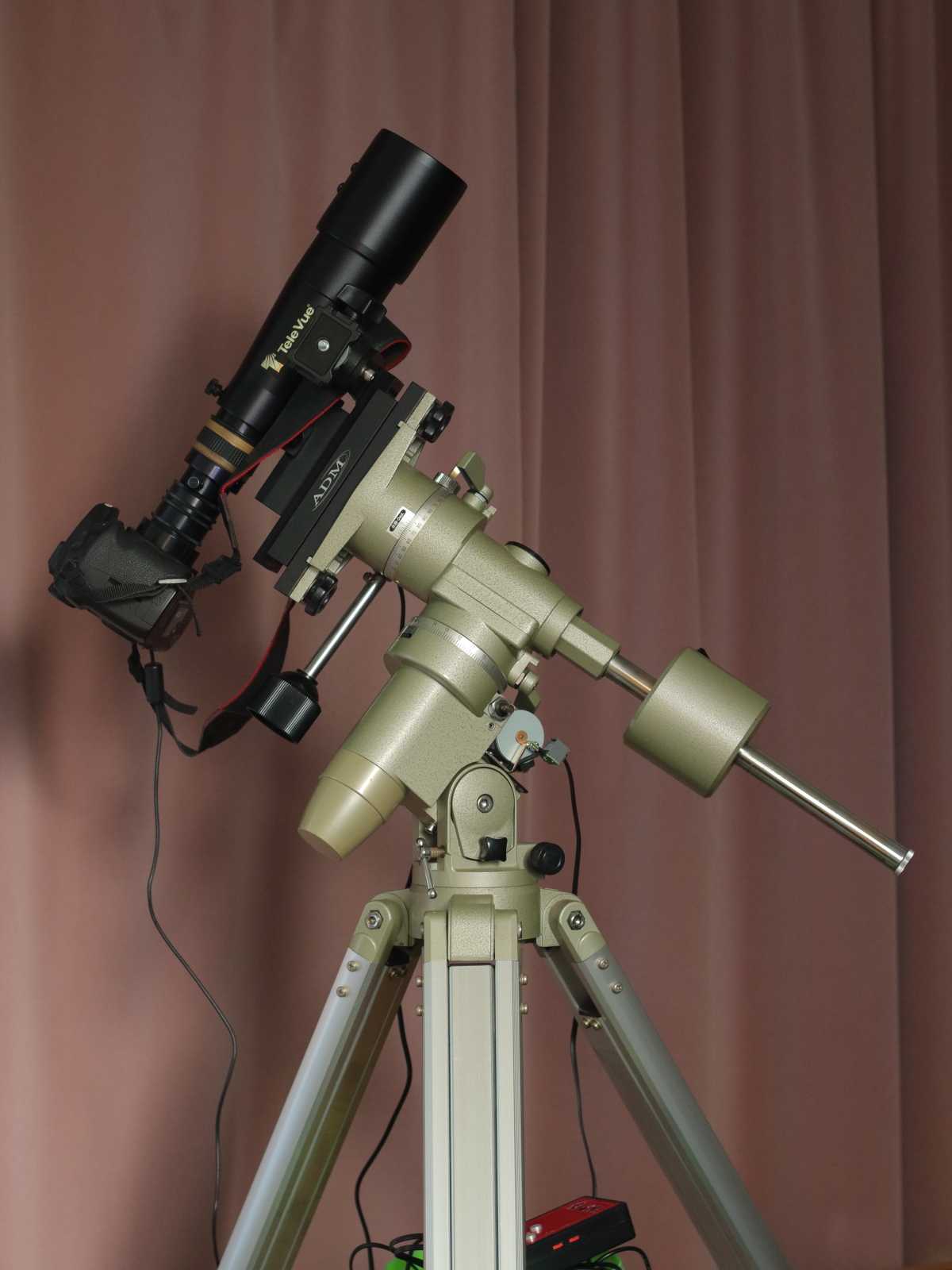
Here's a picture of the trusty Tele Vue-60 (the same scope I use for most of my wildlife shots) in its latest mode atop the equally trusty Vixen Super Polaris mount (fitted with Skywatcher dual-axis motor drives and an ADM dovetail plate adaptor):


With a field-flattener attached the TV-60 is roughly equivalent to a lens of 400 mm focal length. So far, this arrangement is good enough for exposures up to about two minutes duration depending on the accuracy of my polar alignment. (The Skywatcher handset does have an ST-4 port for autoguiding should I wish to attempt longer exposures in the future.) Here's another angle showing the motor drives attached to the Right Ascension and Declination axes:


Any serious astrophotographers visiting this blog might be shaking their heads at this point and muttering about vignetting and edge-of-field distortion, red sensitivity, thermal noise etc. in much the same way that serious wildlife photographers might mutter about autofocus and aperture control when they see what I'm using. But the point is, I don't get enough clear, moonless nights a year to justify spending the kind of megabucks that others spend on their gear. And, crucially, I can use the same DSLR and the same little scope for multiple purposes (which probably explains why the focuser is starting to look a little worse for wear). And (whisper it quietly) one good photo of the Orion Nebula looks very much like another good photo of the Orion Nebula, no matter where you are on the earth. Unless you have your own observatory equipped with an adaptive optics system, you're probably not breaking new ground.

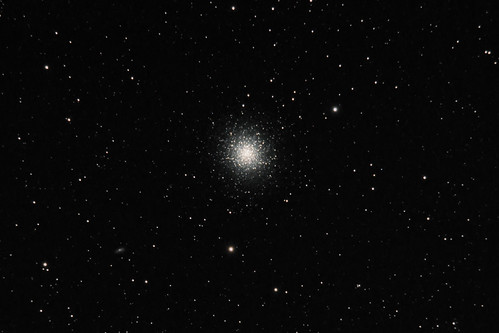
That's not to say I won't be eagerly imaging the Orion Nebula when I get the chance just like every other amateur, but M42 is a spectacle of the winter sky, so for my first target I chose the globular cluster M13 (because it's big, bright, and not too far away from the north celestial pole):

M13 Globular Cluster
M13, Tele Vue-60 + Canon 80D (30 x 1 min @ ISO 800)

The long exposure times required to make an image like this turn pinprick stars into blobs of light, giving the false impression that they are almost touching each other. Although direct interactions in globular clusters do occasionally happen (the most likely origin of blue stragglers), the average distance between stars in a typical globular is actually 0.1 to 0.5 light-years, a fraction of the distance between here and Proxima Centauri (4.2 light-years), but still many times the size of our planetary system. This image from the Hubble Space Telescope resolves the core of M13, giving a better impression of the star density. Around 150 globular clusters are known to orbit our galaxy, dipping in and out of the galactic plane in highly inclined orbits. To put that in perspective, M87, the giant galaxy at the heart of the Virgo Cluster, is surrounded by 16,000 globular clusters.

I recently had the pleasure of looking at M13 through a 10-inch telescope and the result was breath-taking (so much so that I completely forgot to look for NGC 6207 - the "little" galaxy visible towards the bottom-left of the image above).

In my 4-inch achromat M13 takes on the appearance of a "grainy snowball thrown against a pane of glass", always on the brink of being resolved but never quite making it, except when averted vision is employed. In the 10-inch scope (at 133x magnification with a 9mm Nagler eyepiece) it was transformed into a vast three-dimensional city of stars, its brighter members glinting like crushed diamonds right across the face of the cluster, with hundreds - perhaps thousands - more revealing themselves in averted vision. The longer I looked, the more impressive it became, as I began to discern chains of stars arcing out from the centre.

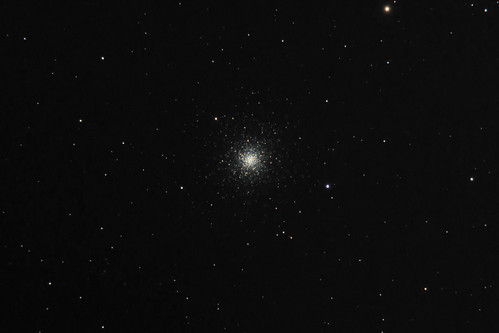
M13 is arguably the most spectacular globular cluster visible from UK latitudes, but there are several others which run it close, such as M3 in the constellation Canes Venatici:

Messier 3
M3, Tele Vue-60 + Canon 80D (31 x 1 min @ ISO 800)

Of course, acquiring the images is only half the battle; processing them is an art-form in itself. I'll leave those details for another time as I'm still very much a beginner at this, but if you want to know what software I used, the links are here.

In the meantime, if you ever get the opportunity to look at M13 or any of the other showpiece globulars through a medium to large-sized telescope, I strongly recommend it. Drink in the spectacle, contemplate what you're seeing, and then look at it again. Photographs just can't do it justice.

See more of my TV-60 deep-sky photos on Flickr.


*Famous last words... While I was drafting this post, He-Who-Must-Not-Be-Retweeted announced the creation of SPACE FORCE (I swear I can hear the echo as I'm typing it). It seems there really is no escape from the Tangerine Nightmare.

Sunday, 13 May 2018

Birds of East Kent: Kestrel

Latest in an occasional series of posts discussing the different birds that can be found in East Kent and how easy (or not) it is to get a decent picture of them.

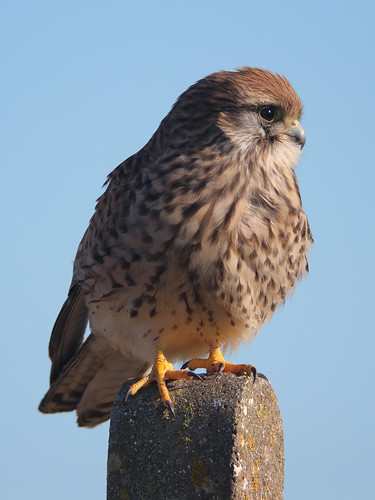
Kestrel (Falco tinnunculus)

I don't usually bother with top-ten lists or stuff like that, but if I had to choose a favourite bird it would undoubtedly be the Kestrel. It's not the biggest (or smallest) bird of prey; nor is it the most colourful. It's not even the only British bird that hovers, though the other contenders can't hope to match its precision or its tenacity. But, more than any other bird, it's always been a small part of my life in some shape or form. It was there on the striking red badge I received when I joined the YOC:


It was there in Ken Loach's famous film (adapted from the novel by Barry Hines) that I saw in my early teens. And it was there at the start and end of the summer holidays, glimpsed from the side window of a car; a bird that seemed to defy not just gravity but time itself as it hovered above the roadside verges while the twentieth century flowed around it.

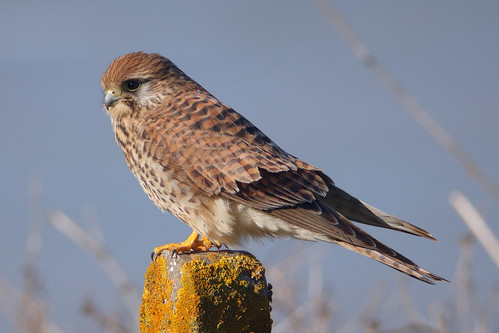
Kestrel (Falco tinnunculus)

I've had the privilege of seeing a wild kestrel up close on a couple of occasions, most recently in February of this year when I encountered one perched in a small tree by the North Foreland golf course. I took some photos and continued on to Botany Bay to see if there was anything interesting on the shore. When I turned around to walk back I was surprised to see the same kestrel standing on a fence post. Naturally, I couldn't pass up the opportunity to take some more photos:

Kestrel (Falco tinnunculus)

From badges to films to poetry (see: The Windhover by Gerard Manley Hopkins) there is something about the kestrel that seems ingrained in the British psyche. A good example of this can be found in Powell and Pressburger's 1944 wartime classic A Canterbury Tale. In the film's prologue, a group of medieval pilgrims make their way towards Canterbury while a voiceover narrates a passage from Chaucer's text. A falconer stops to release a kestrel into the sky. The bird dips and soars ... and transforms into a Spitfire flying above the English countryside. Four hundred years of history spanned in a single cut.


If the description of that scene rings a bell it's because Stanley Kubrick used the same trick in the famous bone-to-spacecraft transition in 2001: A Space Odyssey. Coincidence, homage or blatant rip-off? It's a question that's been debated for fifty years, and will probably be debated for fifty more. In the meantime, the kestrel continues to soar above fields, along cliff-tops, and across marshes - hovering, observing, sometimes descending for prey, and then moving on, seeing colours that no human eye can see as it patiently constructs its daily map of the world.

Effortlessly at height hangs his still eye.
His wings hold all creation in a weightless quiet,
Steady as a hallucination in the streaming air. 
Ted Hughes, The Hawk in the Rain (1957)


See also:
More of my Kestrel photos on Flickr
Kestrel (RSPB)
Kestrel (Birdforum)
Kestrel (Birdguides)

Friday, 8 April 2016

Oare Marshes

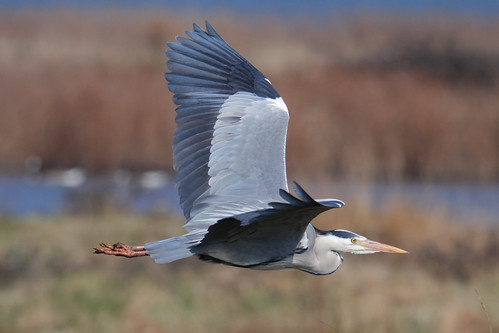
Grey Heron in Flight

Alternative Title: A long overdue write-up of a long overdue trip 


The Oare Marshes KWT reserve is a bit further afield than my usual haunts, but I fancied a change of scene and so I took advantage of a warm March day to pay my first visit. The walk from Faversham station is actually quite pleasant if you don't mind a bit of a trek, but it seems a lot of the visiting photographers/birders park along the road that runs through the middle of the reserve, get the required photos/ticks, and then drive off to the next location - sometimes without even leaving their cars! Such is the accelerated and competitive nature of modern life, but you'll forgive me if I prefer a more sedate approach.

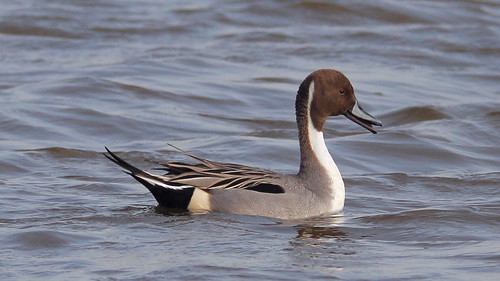
Pintail (Anas acuta)

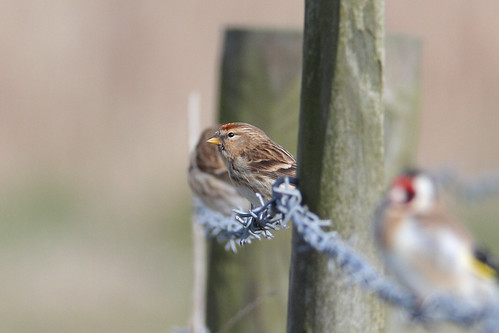
The reserve is quite contained; you can walk all the way around it a lot quicker than, say, the extended Grove Ferry/Stodmarsh circuit. I must have walked round it one-and-a-half times while I was there - perhaps more if you factor in the distance I covered trailing after the mixed flock of Goldfinches and Lesser Redpolls:

Lesser Redpolls (Carduelis cabaret)

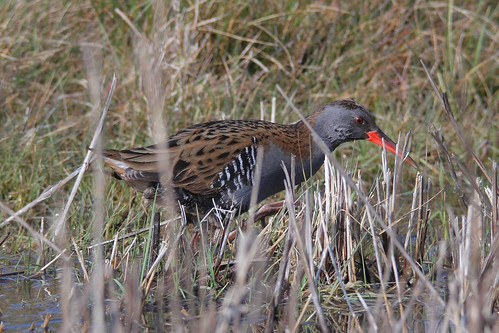
For those who wish to give their feet a rest, there are three hides on the reserve. On the day I visited they were all in pretty good condition. They also happened to be completely empty, which is not entirely surprising given that a) there were no birds anywhere near them, and b) they were facing directly into the wind - which made for an eye-watering experience. Fortunately most of the highlight species could be seen quite easily from the viewing points along the road, including this uncharacteristically obliging Water Rail:

Water Rail (Rallus aquaticus)

I don't generally keep lists, but on this occasion I jotted down all the birds I'd seen and heard (written that same evening, from memory). I counted forty-one different species, which were - for those who are interested in such things - as follows: Avocet, Bearded Tit, Blackbird, Black-headed Gull, Black-tailed Godwit, Blue Tit, Canada Goose, Carrion Crow, Cetti's Warbler, Coot, Curlew, Dunnock, Goldfinch, Green Woodpecker, Grey Heron, Greylag Goose, Herring Gull, Lesser Redpoll, Little Egret, Little Grebe, Magpie, Mallard, Marsh Harrier, Meadow Pipit, Moorhen, Mute Swan, Oystercatcher, Peregrine Falcon, Pintail, Redshank, Reed Bunting, Robin, Shelduck, Shoveler, Skylark, Snipe, Starling, Teal, Tufted Duck, Water Rail, and Wood Pigeon.

Not bad for a first visit, though having read subsequent reports it's possible that I may have walked past a Little Owl without spotting it. Sounds like a good excuse for a return trip...


See also:
More of my photos from Oare Marshes
Oare Marshes (Kent Wildlife Trust)
Oare Marshes Latest Sightings (KOS)

Monday, 5 October 2015

Photographing the 2015 Total Lunar Eclipse

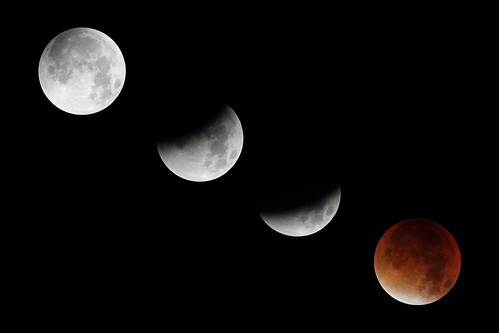
Lunar eclipses aren't that rare - certainly not as rare as some uninformed sections of the media would have you believe, but I hadn't photographed one since March 2007, so I stayed up till stupid o'clock the other week to get some images of the so-called Super Blood Moon eclipse. The wind was a little gusty, but fortunately the clouds didn't interfere.

"Supermoon" Eclipse (Canon 7D + Televue-60)

One thing the photos don't convey is just how much the moon dims during totality. (The reason it doesn't go completely dark is because it's illuminated by sunlight refracted through the earth's atmosphere. Or to put that in a slightly more lyrical way, an observer standing on the moon during an eclipse would see all of the earth's sunrises and sunsets compressed into a beautiful ring of light.) The first image in the sequence above (the barely eclipsed moon) was shot hand-held with a 1/1600 second exposure at ISO 800. The last shot (fully eclipsed) was taken on a tripod with a cable release, with the mirror lock-up function enabled; exposure time 1/2 second, ISO 1600. At long focal lengths (400 mm and above), these slow exposure times can be problematic. Shoot for anything longer than about half a second and the earth's rotation will start to smear the image.

So, as is often the case in astrophotography, there's a trade-off to be made. Do you under-expose and increase noise, or do you expose correctly and lose detail? A tracking mount which will correct for the earth's rotation is one way around the problem, but the good ones don't come cheap. Another method (if you find high ISO noise objectionable) is to shoot lots of under-exposed images one after the other, stack them in RegiStax or AviStack to increase the signal-to-noise ratio, and then push the exposure in Photoshop. I did think about doing this, but it was late and I was tired and it seemed like a lot of effort given that I still had several hundred photos from the Camargue to sort through (a post on that is coming soon).

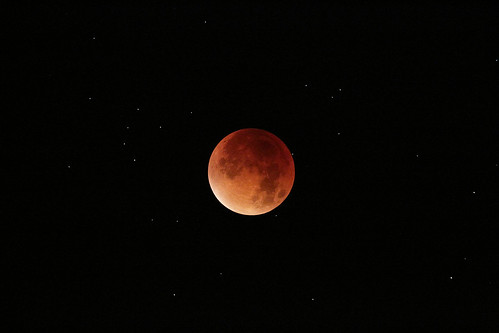
Maybe it's something I'll try for the next eclipse in 2018; or maybe by then cameras will have progressed so much that high ISO noise won't be a big deal... Anyway, to tide us over till then, here's an uncropped view of the eclipse taken at ISO 6400, and carefully pushed in PS to bring out the background stars. A red full moon surrounded by stars; now that's a sight worth staying up for.

The Moon and the Stars

Wednesday, 8 July 2015

Fast Bikes and Red Kites

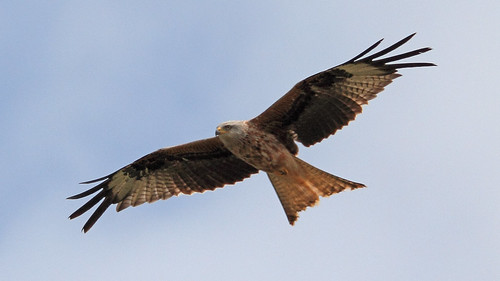
Red Kite (Milvus milvus)

A noisy race circuit isn't the first place you'd expect to find interesting wildlife, but a trip to Lydden Hill last Saturday turned up an surprise bonus in the unmistakeable shape of a Red Kite. It spent a good half-hour hunting along a tree-line just to the east of the circuit, during which time I was able to get close enough for the kind of view you'd normally have to travel at least as far as Oxfordshire to see.

Red Kite with prey, Lydden Hill, July 2015.

The trees prevented me from spotting whether the Kite was scavenging or targeting live prey, but it reappeared with at least two successful catches, one of which it ate on the wing, Hobby-style:

In-flight meal, Lydden Hill, July 2015.

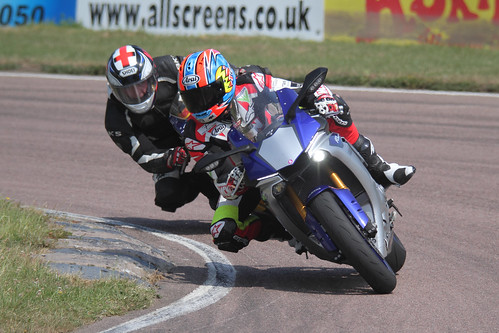
And as if that wasn't enough a Buzzard also showed up, giving me hope that I'd get a photo or two of both birds locked in combat, but a pair of angry crows intervened to escort the buzzard "off the premises". Later, with the bigger birds-of-prey out of the way, two Kestrels came to hunt in the same area. Oh, and in case you're wondering, I did remember to photograph some bikes while I was there.

  Lydden Track Day

Monday, 2 March 2015

40D to 7D

Yes I'm aware that I'm half a decade behind the curve, but the trusty Canon 40D had served me so well over the years that I hadn't felt the need to upgrade. (Before that, I'd used a 350D / Rebel XT.) However, in recent months I'd noticed that my photos were starting to look a bit "samey" and I wondered if I was reaching the limits of what I could do with the 40D.

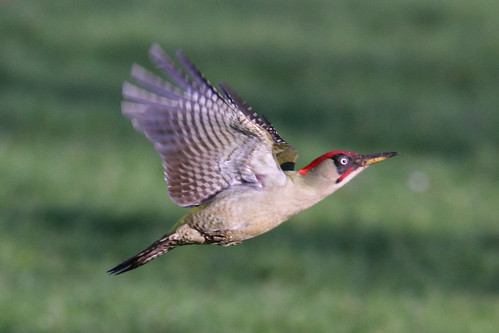
Green Woodpecker in Flight
Canon 7D & Tele Vue-60; 1/1600 sec, ISO 800

Enter the 7D Mk I. Enough's been written about this camera online and in print already, so I'll let the pictures do most of the talking and add a few observations along the way.

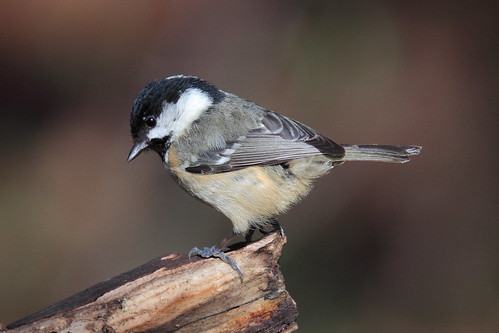
Coal Tit (Periparus ater)
Canon 7D & Tele Vue-60; 1/1250 sec, ISO 640

10 to 18 Megapixels: I was worried that all those extra pixels might magnify the shortcomings of my style of shooting (mostly hand-held, with a manual-focus telescope) rather than improve the quality of my photos, but it turns out the 7D is an excellent match for the Tele Vue-60 (my wildlife lens of choice). I now have much more leeway to crop and re-frame the subject while still being able to produce a decent-sized print if necessary.

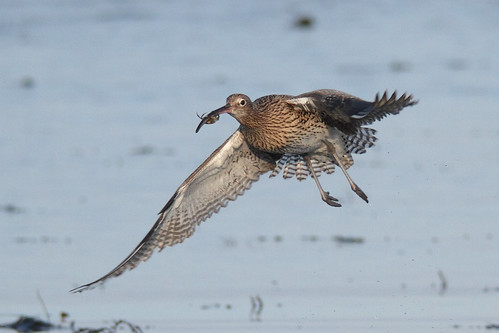
Curlew (with crab)
Canon 7D & Tele Vue-60; 1/2000 sec, ISO 800

Auto ISO: Although this was a feature on the 40D, it never really lived up to its potential. On the 7D it does. Whereas before I used to shoot in Aperture-Priority AE (Av) and let the camera choose the exposure time, I can now shoot in Shutter-Priority AE (Tv), choose a shutter speed appropriate for the subject and the focal length of the TV60 (typically anywhere from 1/1000 sec to 1/2500 sec depending on how much coffee I've drunk that morning), set the Exposure Compensation for the lighting conditions, and let the camera choose the correct ISO.

Moorhen (Gallinula chloropus)
Canon 7D & Tele Vue-60; 1/1600 sec, ISO 2000

Noise: From what I've seen on Internet forums, this seems to be the biggest bone of contention about the 7D, with some users getting very clean images all the way up to ISO 3200, and others claiming it's unusable above ISO 800! (It's worth noting here that because of the way a Bayer filter works, the camera captures twice as much information in the green channel as it does in the other two channels, which may explain why photos of birds against blurred green backgrounds seem to show less noise.) Personally, I don't mind a bit of noise as long as it isn't too obtrusive, and I actually prefer a bit of grain over the plasticky effect you see in some over-processed photos. With regards to the 7D, I find that the RAW conversion needs a little more fine-tuning in Digital Photo Professional than I'm used to, but with care I can get an image at ISO 3200 which is no noisier than an image taken at ISO 1600 with the 40D. This, when you factor in the higher resolution of the 7D, is a considerable improvement. Obviously, I'm still getting used to the camera as well adapting my methods of post-processing, but my impressions so far are overwhelmingly positive. Also, it seems to me that the 7D sometimes errs slightly on the side of over-exposure, which ironically can make for a cleaner final photo.

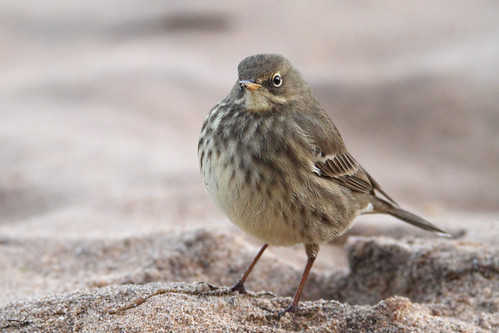
Rock Pipit (Anthus petrosus)
Canon 7D & Tele Vue-60; 1/1600 sec, ISO 3200

Are my photos significantly better? The Flickr community seems to think so. I know that comments and faves aren't always a reliable measure of quality, but my views have shot up since I started posting photos taken with the 7D, with at least four images hitting the giddy heights of Explore. Or is all that traffic a side-effect of people searching for photos taken with the 7D Mark II?

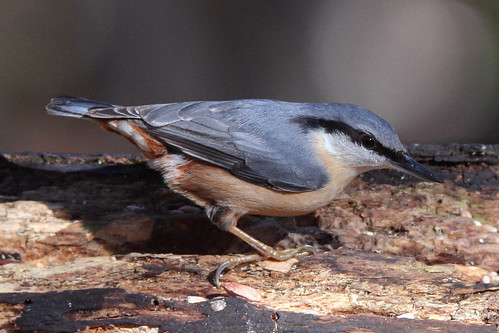
Nuthatch (Sitta europaea)
Canon 7D & Tele Vue-60; 1/1250 sec, ISO 1250

Decide for yourself: see more of my photos taken with the Canon 7D.

Sunday, 30 June 2013

Birds of East Kent: Marsh Harrier

Latest in an occasional series of posts discussing the different birds that can be found in East Kent and how easy (or not) it is to get a decent picture of them.

Marsh Harrier

This bird of prey (the largest of the harriers) is one of the showpiece species of East Kent (maybe even of the whole county) and the RSPB website rightly lists Stodmarsh (where it can be found all year round) as one of its strongholds. Indeed, a visit to Grove Ferry / Stodmarsh doesn't feel complete without a sighting of one of these majestic birds gliding over the reedbeds in search of prey. And yet, for all the times I've seen them, I've still to acquire what I consider a really good picture. You'd think, for their size and languid flight, it would be easy to see them approaching, but they have a knack for suddenly appearing out of nowhere and then either plunging into the reeds or spiralling up on a thermal. You may not know where they are, but they always seem to know where you are.

Marsh Harrier comparison

Male and female Marsh Harriers are fairly easy to tell apart; males (above left) are lighter, with characteristic dark wing-tips. Females (above right) are bulkier and darker, with cream-coloured crowns. Juveniles appear similar to the adult females, but are distinguished by their golden crowns.

During the breeding season, male Marsh Harriers show off to the females with spectacular displays of sky-dancing (and if the wind's blowing the right way you can hear them calling to each other). This aerial prowess serves a valuable purpose later on as the male will be required to pass food to the female in mid-air rather than bring it directly to the nest. These food items are usually small birds as far as I've been able to tell, but I imagine the ubiquitous Marsh Frog must make up a large part of their diet.

Marsh Harrier (+ food pass)

My most memorable sighting of a Marsh Harrier came - ironically enough - not at Grove Ferry, but at Minster a few years ago. I set off on what I thought was going to be a clear sunny morning, but arrived on the marshes to find the whole area shrouded in a thick bank of fog. As I walked alongside the river waiting for the sun to break through, a large shape rose out of the mist just twenty feet away and I found myself face to face with a Marsh Harrier. It flew gracefully in front of me and disappeared into the fog on the other side of the river. I didn't take any pictures (they wouldn't have come out anyway), but on that occasion it was just a privilege to get that close to one of Britain's most captivating birds of prey.

See also:
More of my Marsh Harrier photos on Flickr
Marsh Harrier (RSPB)
Marsh Harrier (Birdforum)


Friday, 31 May 2013

Have I Got Newts For You

This time last year I'd never knowingly seen a newt outside of a book or a TV programme. Then, in a pond not far from where I work, I spotted several of these:

Great Crested Newt larva

This, I subsequently found out, is the larval form of the Great Crested Newt, the largest - and most endangered - of the three species of newt native to Britain. With its rough, granular skin, scythe-like tail and impressive jagged crest, the adult male Great Crested Newt is the closest you'll come to seeing a dragon in the English countryside, so - as you can imagine - I was rather keen to get a photo of one.

Like a lot of creatures, Great Crested Newts look at their best during the breeding season (i.e. now), but trying to photograph them is easier said than done. I quickly found out that they rarely come up to the surface, and when they do they typically dive straight back down again before you can get the camera anywhere near them. In the meantime, I had to console myself with getting pictures of the smaller Smooth (Common) Newt:

Smooth Newt

...and the equally diminutive Palmate Newt, with its distinctive webbed hind feet and tail filament:

Palmate Newt (Lissotriton helveticus)

But still no photos of a Great Crested Newt.

Then, just when it seemed that the pond would be covered with lily-pads before I even got so much as a single shot, my Great Crested Nemeses finally decided to cooperate:

Great Crested Newt (Triturus cristatus)

Okay, so they're not the cleanest photos I've ever taken, but shooting subjects in a pond (as opposed to a brightly-lit aquarium) is never easy at the best of times, and you can only do your best with what you've got. If you're trying it yourself I recommend a fast, close-focusing lens in the 100 - 300 mm range ... and a great deal of patience.

P.S. I apologise for the terrible pun headlining this post, but it was either that or the even more lame "Goodness Gracious, Great Crested Newts!"


See also:
More of my newt photos on Flickr
Great Crested Newt Conservation Handbook (froglife.org)


Sunday, 17 March 2013

Birds of East Kent: Wheatear

Latest in an occasional series of posts discussing the different birds that can be found in East Kent and how easy (or not) it is to get a decent picture of them.

Wheatear
North Foreland, Broadstairs, September 2012

Supposedly named for the white rump it shows during flight (Wheatear = "white arse", geddit?), the Northern Wheatear (to give it its full title) is perhaps East Kent's best example of a passage migrant. We see them twice a year: once in springtime when they stop off on their way to their breeding grounds, and again in autumn as they prepare to make the long journey back to sub-Saharan Africa.

Appearance-wise, they're hard to confuse with any other bird. The spring male in its full breeding plumage is a particularly impressive sight with its dark chocolate-brown wings, blue-grey back, black eye-mask and peach-coloured flush on its breast and throat.

Wheatear (Oenanthe oenanthe)
Bishopstone, Reculver, April 2010

Wheatears are fairly easy birds to locate, as they can be seen just about anywhere along the coast during the peak of the spring and autumn migrations. The rocks at Bishopstone are usually a reliable place to look, as are the scrubby cliff-tops and strips of grass between North Foreland and Foreness.

In some years, if the weather keeps them grounded, they can build up to impressive numbers as they gather along the coast. I remember one autumn afternoon when they were literally popping up out of every bush I passed as I walked from King George VI park to Broadstairs. (I suppose this was the Wheatear equivalent of Operation Stack.)

However, getting close enough to acquire a decent photo requires a little forethought. Although Wheatears spend a lot of their time on the ground, they frequently fly up to the nearest available perch to see what's going on around them. One method (a trick I learned from observing similar behaviour in Stonechats) is to advance quickly while they're feeding and immediately freeze as soon as they fly to their perch. It may take a while, but with practice and persistence you should be able to get very close indeed. Another method is to observe if they're moving in a particular direction and surreptitiously get ahead of them. Then it's a matter of keeping still as they work their way towards you. (And of course not making making the schoolboy error of suddenly raising your camera.)

Wheatear at Viking Bay
Viking Bay, Broadstairs, October 2011

Wikipedia lists 21 other species of Wheatear, a couple of which occasionally make it to British shores. But considering how far these birds travel, it's a privilege to see even the regular ones.

See also:
More of my Wheatear photos on Flickr
Wheatear (RSPB)
Wheatear (Birdforum)
Wheatear (Birdguides)

Saturday, 2 March 2013

The Birds of Bossenden Wood

If Wikipedia is to be believed (and if Millwall vs West Ham doesn't count), Bossenden Wood is the site of the last battle fought on English soil, which supposedly lasted for just a few violent minutes in May 1838. These days the only battles you're likely to see here are between the different species of birds as they fight over the various nuts and seeds that the photographers have laid out for them. Purists might regard this as cheating, but I know from experience (having spent many hours wandering around the larger Blean complex hearing lots and seeing little) how challenging it is to photograph woodland birds, so in this instance I have no qualms in resorting to "bribery".

This is the best time of year to photograph woodland birds, as there is less foliage to block the light. I'd been planning to visit Bossenden all winter but it wasn't until earlier last month that a window of opportunity (and blue sky) arrived. I brought plenty of bird food with me, but I needn't have bothered as the conveniently-situated log had already been well baited. So, all I had to do was take my place alongside the other photographers and snap away. My target species were Coal Tit, Marsh Tit and Nuthatch, and I'm pleased to say I got all three of them - with varying degrees of success.

The Nuthatches were the hardest to shoot, staying only long enough to grab a nut and then fly off with it in their characteristic commando style.

Nuthatch (Sitta europaea)

Coal Tits were present in good number and were much more obliging (except when they were chasing each other through the trees).

Coal Tit (Periparus ater)

Marsh Tits were less numerous, and I only really got two or three usable shots.

Marsh Tit (Poecile palustris)

This smart male Chaffinch also got in on the act, and posed so nicely it would have been rude not to take its picture.

Chaffinch (Fringilla coelebs)

And as if that wasn't enough, I also saw Blue Tits, Great Tits, a noisy Blackbird and a group of Long-tailed Tits.

Bossenden Wood also plays host to the red-listed Lesser-spotted Woodpecker. I didn't see one on this occasion (not that was I expecting to on my very first visit), but the show put on by the other birds more than made up for it.

See also:
More of my photos from Bossenden Wood (Flickr slideshow)
Kingsdowner: Bossenden Wood


Sunday, 13 January 2013

Birds of East Kent: Snow Bunting

Latest in an occasional series of posts discussing the different birds that can be found in East Kent and how easy (or not) it is to get a decent picture of them.

Snow Bunting
Palm Bay, Margate, March 2012

The Snow Bunting is a regular winter visitor to Kentish shores, albeit never in huge numbers. They can pop up just about anywhere along the East Kent coastline, but the most reliable place to find them is along the shingle beaches at Reculver, foraging amongst the pebbles.

I like to think of this smart little bird as the "photographer's friend" because not only is it very photogenic, it can also be very approachable. But of course, a flock of birds is only as brave as its least brave member, and so the closest you get to a larger group of Snow Buntings (known collectively as a "drift") may be when they fly over your head to the other end of the beach - half an hour's walk in the direction you just came from. However, if you're fortunate enough to find a Snow Bunting by itself (no easy task, since they usually blend in very well with the pebbles) and don't make any sudden movements, it may allow you to get within a few feet. The bird pictured below was so confiding I had to back away just to keep it in focus.

Portrait of a Snow Bunting
Kingsgate Bay, Broadstairs, April 2011

In summer, when they return to their breeding grounds in the high Arctic, the Snow Buntings undergo a dramatic change, with the males turning almost completely white. Here in Kent, they're invariably gone before we see them reach this phase, but if you're lucky enough to catch a straggler you might see the white plumage starting to come through. Compare the difference between the one above (photographed in early spring) with the one below (taken in late autumn).

Snow Bunting
Reculver, November 2009

So the next time you go for a walk along the coast on a bracing winter's day, keep your eyes open for these charming little birds. They may be closer than you think.


See also:
More of my Snow Bunting photos on Flickr
Snow Bunting (RSPB)
Snow Bunting (Birdforum)

Tuesday, 9 October 2012

Ocean of Storms

Oceanus Procellarum

At first glance Oceanus Procellarum (the Ocean of Storms) appears to be one of the less interesting regions of the Moon, presenting to the casual observer nothing more than a vast, monotonous plain of dark grey lava, dotted with the occasional impact crater. But look closer and you'll find evidence of ancient volcanism on a huge scale, unlike anywhere else on the lunar surface.

Here's a 100% crop showing the Aristarchus plateau - an diamond-shaped block of uplifted terrain dominated by the dazzling crater Aristarchus and the 160 km-long Schröter's Valley:


Easily visible in a small telescope, the valley is the largest and perhaps most dramatic example of a lunar rille, a sinuous channel cut (a very long time ago) by fast-flowing lava.

Follow the terminator south and you come to the Marius Hills, a complex of some 300 volcanic domes and hills that - through a small telescope - look like pimples on the lunar surface:


Lunar Orbiter 2 photographed the complex from an oblique angle, giving an idea of the relative height of the domes, and a few decades later the Japanese SELENE/Kaguya mission discovered an intriguing dark pit in the area (shown here in a high-resolution image taken by the Lunar Reconnaissance Orbiter).

Incidentally, if you move your mouse over the cropped images you can compare the finished versions with one of the original photos, illustrating the dramatic improvement that image-stacking can make to lunar photography.


See also:
Procellarum: The Biggest Basin?
Shooting the Moon: Lunar Photography with a DSLR and a Small Refractor

Monday, 10 September 2012

HC SVNT DRACONES

As beautiful as the Kent countryside and its surrounding coastline is, you know that wherever you go, you're never too far away from a road or a housing estate or an out-of-town shopping centre. It's still possible to get lost, but you can never get truly lost, and there are certainly no uncharted territories to speak of - the kind that medieval mapmakers used to populate with dragons and other mythical creatures. (Though if there were an uncharted region on the map of South East England, you can be sure that someone from the current government would try and put a runway on it.)

The thought of hundreds of shoppers dropping their bags and running in terror as a dragon wheels in the skies over the Westwood Cross is a strangely comforting one (well, to me at least), but in the absence of fire-breathing dragons, we have to make do with their insect counterparts. And judging by the number of dragonfly photos I've seen on Flickr recently, I think it's safe to say it's been a pretty good summer for dragonflies (and their damselfly cousins).

Over the last few months, at just one modest-sized pond in Canterbury, I've seen dragonflies of all different sizes and colours, including red ones:

Red on Green

...blue ones:

Broad-bodied Chaser

...yellow ones:

Broad-bodied Chaser

...and hawkers with colour schemes worthy of a Formula 1 car:

X-Wing

On reflection, perhaps it's just as well that the dragons' diminutive namesakes don't breath fire, as the above encounter might have burned the end of my telescope.