I'll say one good thing for He-Who-Must-Not-Be-Retweeted; he's encouraged me to turn my attention away from this increasingly nonsensical planet and back into deep space*. I've dabbled with astrophotography before (hand-tracking with a 50 mm lens), but mostly I've stuck to the brighter objects like the moon and Jupiter. Long-exposure astrophotography at focal lengths greater than 300 mm requires precise motorised tracking, but it was only after a trip to
Astrofest 2018 (and some intensive research) that I figured out a practical and affordable way to go about it.
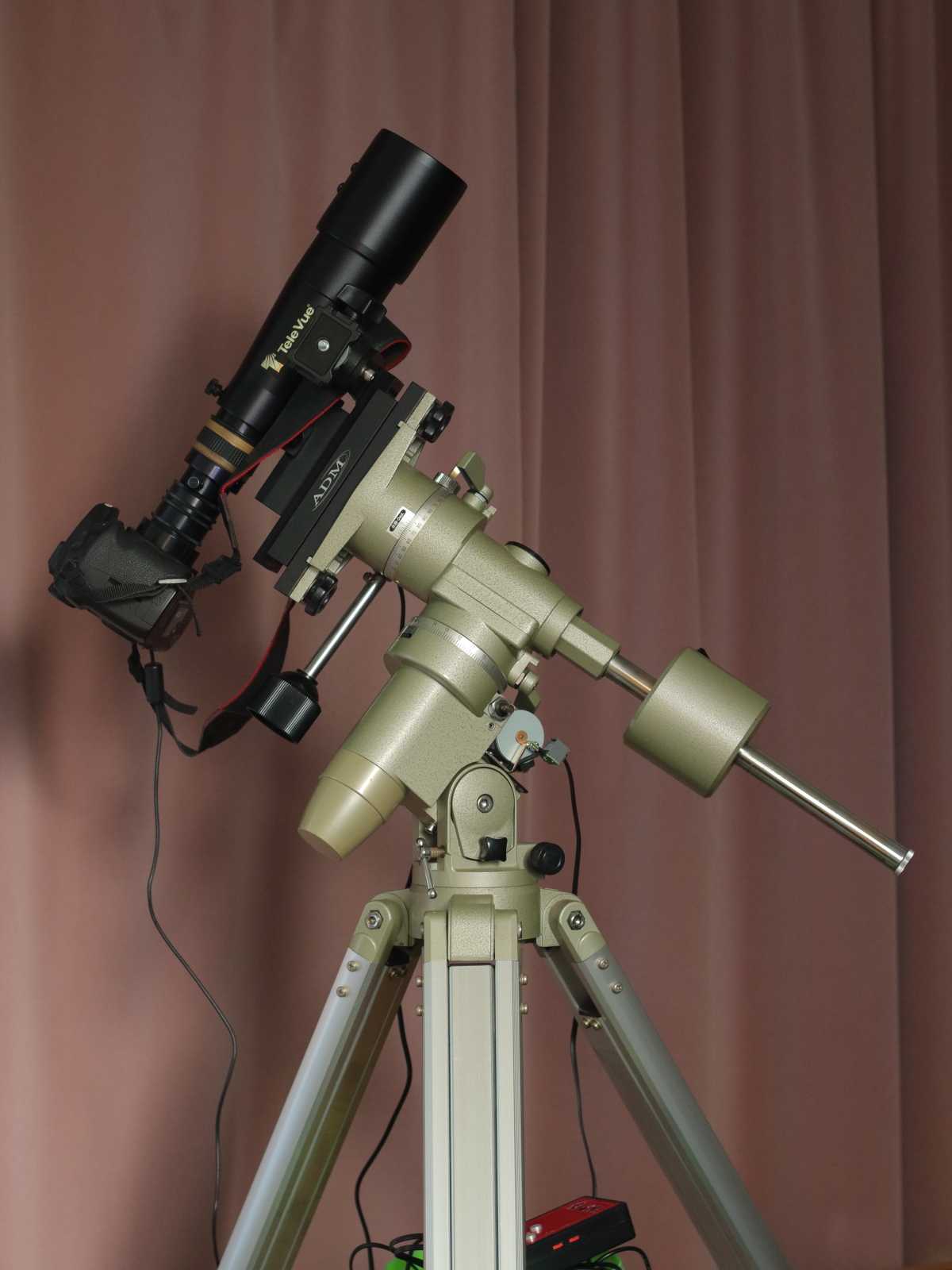
Here's a picture of the trusty Tele Vue-60 (the same scope I use for most of my wildlife shots) in its latest mode atop the equally trusty Vixen Super Polaris mount (fitted with Skywatcher dual-axis motor drives and an ADM dovetail plate adaptor):
With a field-flattener attached the TV-60 is roughly equivalent to a lens of 400 mm focal length. So far, this arrangement is good enough for exposures up to about two minutes duration depending on the accuracy of my polar alignment. (The Skywatcher handset does have an ST-4 port for autoguiding should I wish to attempt longer exposures in the future.) Here's another angle showing the motor drives attached to the Right Ascension and Declination axes:

Any serious astrophotographers visiting this blog might be shaking their heads at this point and muttering about vignetting and edge-of-field distortion, red sensitivity, thermal noise etc. in much the same way that serious wildlife photographers might mutter about autofocus and aperture control when they see what I'm using. But the point is, I don't get enough clear, moonless nights a year to justify spending the kind of megabucks that others spend on their gear. And, crucially, I can use the same DSLR and the same little scope for multiple purposes (which probably explains why the focuser is starting to look a little worse for wear). And (whisper it quietly) one good photo of the Orion Nebula looks very much like another good photo of the Orion Nebula, no matter where you are on the earth. Unless you have your own observatory equipped with an adaptive optics system, you're probably not breaking new ground.
That's not to say I won't be eagerly imaging the Orion Nebula when I get the chance just like every other amateur, but M42 is a spectacle of the winter sky, so for my first target I chose the globular cluster
M13 (because it's big, bright, and not too far away from the north celestial pole):
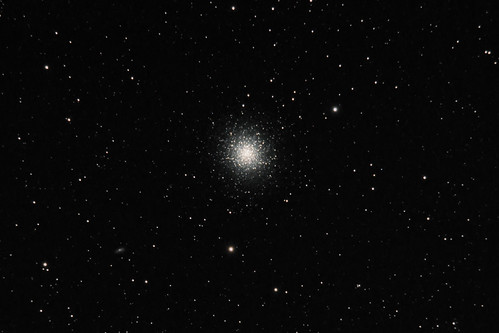 |
| M13, Tele Vue-60 + Canon 80D (30 x 1 min @ ISO 800) |
The long exposure times required to make an image like this turn pinprick stars into blobs of light, giving the false impression that they are almost touching each other. Although direct interactions in globular clusters do occasionally happen (the most likely origin of
blue stragglers), the average distance between stars in a typical globular is actually 0.1 to 0.5 light-years, a fraction of the distance between here and Proxima Centauri (4.2 light-years), but still many times the size of our planetary system.
This image from the Hubble Space Telescope resolves the core of M13, giving a better impression of the star density. Around 150 globular clusters are known to orbit our galaxy, dipping in and out of the galactic plane in highly inclined orbits. To put that in perspective, M87, the giant galaxy at the heart of the Virgo Cluster, is surrounded by
16,000 globular clusters.
I recently had the pleasure of looking at M13 through a 10-inch telescope and the result was breath-taking (so much so that I completely forgot to look for NGC 6207 - the "little" galaxy visible towards the bottom-left of the image above).
In my 4-inch achromat M13 takes on the appearance of a "grainy snowball thrown against a pane of glass", always on the brink of being resolved but never quite making it, except when averted vision is employed. In the 10-inch scope (at 133x magnification with a 9mm Nagler eyepiece) it was transformed into a vast three-dimensional city of stars, its brighter members glinting like crushed diamonds right across the face of the cluster, with hundreds - perhaps thousands - more revealing themselves in averted vision. The longer I looked, the more impressive it became, as I began to discern chains of stars arcing out from the centre.
M13 is arguably the most spectacular globular cluster visible from UK latitudes, but there are several others which run it close, such as
M3 in the constellation Canes Venatici:
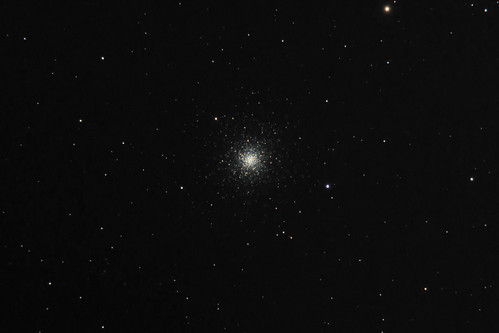 |
| M3, Tele Vue-60 + Canon 80D (31 x 1 min @ ISO 800) |
Of course, acquiring the images is only half the battle; processing them is an art-form in itself. I'll leave those details for another time as I'm still very much a beginner at this, but if you want to know what software I used,
the links are here.
In the meantime, if you ever get the opportunity to look at M13 or any of the other showpiece globulars through a medium to large-sized telescope, I strongly recommend it. Drink in the spectacle, contemplate what you're seeing, and then look at it again. Photographs just can't do it justice.
See more of my TV-60 deep-sky photos on Flickr.
*Famous last words... While I was drafting this post, He-Who-Must-Not-Be-Retweeted announced the creation of SPACE FORCE (I swear I can hear the echo as I'm typing it). It seems there really is no escape from the Tangerine Nightmare.