Showing posts with label england. Show all posts

Tuesday, 28 May 2019

Into the Whirlpool

Ask someone to draw you a galaxy and chances are they'll come back with a spiral shape. Even a small telescope will show you plenty of galaxies (if you know where to look), but how large a scope do you need to see those dramatic spirals? Edge-on galaxies like M82 and NGC 4565 show lots of detail in modest-sized scopes because their light is concentrated into a smaller area, but the majority of face-on galaxies have such a low surface brightness that the slightest haze or encroaching light pollution can render their spiral arms invisible.

There are a few notable exceptions however, and for northern hemisphere observers, the consensus seems to be that Messier 51 (commonly known as the Whirlpool Galaxy) is the best of the bunch. It resides some 25 million light-years away in the constellation of Canes Venatici (the Hunting Dogs), and can be found high overhead on spring evenings near the tail of the Great Bear (Ursa Major).

Here's a photo I took (actually forty-three 90-second exposures, stacked together) in March, showing the spiral very clearly:


M51 & NGC 5195, 28 Mar 2019; Canon EOS 80D + Tele Vue-60 + Vixen Super Polaris

For a larger crop, see the version on my Flickr page.

Sixty-five minutes' worth of sensor data is one thing, but how much of that detail can you actually see with your own eyes? M51 and its interacting companion NGC 5195 are easy enough to spot through even a small scope, but it wasn't until I got the 10-inch reflector that I was able to see them as more than a pair of faint fuzzy blobs. Even then, the detail was elusive, with the dark spaces between the Whirlpool's arms often more apparent than the arms themselves.

My sketching skills are very rusty so it took me three attempts before I got something I was happy with, but here's an approximation of what M51 looks like through a medium-sized scope on a good night:


For this I used the 10-inch Orion XT10 and a Tele Vue Nagler 9mm eyepiece, giving a magnification of 133x.

Depending on the quality of your night sky, you may be able to see M51's spiral with a smaller telescope. I was never able to make it out with my 4-inch refractor (although the two galaxies themselves were obvious), and even with the XT10 I can't always see it, as demonstrated by these excerpts from my observing notes:

19 May 2018 (first night out with the new scope; sky a little hazy)
Not well placed (wrong side of meridian), but both galaxies showed bright cores. Strong hint of spiral arm structure, and a star superimposed over the face of the galaxy (not a supernova!).
10 February 2019 (cold, but not freezing; sky transparency improved considerably once the crescent moon got out of the way)
In a night of highlights, M51 was the undoubted stand-out. After staring at it for a couple of minutes I suddenly realised I could see the spiral arms quite clearly, defined by the dark space separating them. One arm curling out from core region around a foreground star. A magnificent sight at 133x, even though it was still some way from the zenith. With averted vision it started to look like a ghostly monochrome photo.
31 March 2019 (slightly chilly, windy with occasional strong gusts; transparency good, but not up to the standard set on 10 Feb)
Tonight M51 and NGC 5195 had an almost ghostly aspect about them; the spiral arms seemed to fade in and out of existence independently of averted vision. The view wasn’t substantially improved at 240x, other than highlighting some of the brighter areas with a milky glow. 
4 April 2019 (chilly, gusty evening; excellent seeing, transparency improving as night went on)
Best view of spiral structure since 10 Feb; showed particularly well in averted vision. Dark areas between arms just about visible in direct vision. Also found a faint, round little galaxy roughly south of M51 – not plotted in the Pocket Sky Atlas, but later identified as NGC 5198.

(If you're into this sort of thing and you want to read more of my observing notes, I'm in the process of putting them online at https://mskastro.blogspot.com/ )

The visibility of the spiral is very sensitive to sky conditions, so if you don't succeed on one night, try again on another (and make sure your eyes are fully dark-adapted). Patience and persistence are vital. And here's another tip: if M51's spiral still seems maddeningly faint, steer your scope to the other side of the Great Bear's tail and see what you make of the larger (and fainter) spiral galaxy M101. Trust me, when you return to M51 it will seem positively bright by comparison.

So now you have an idea of what it takes to see the spiral in M51, but what about resolving individual stars in this beautiful galaxy? For that I recommend taking a very deep dive into this image by the Hubble Space Telescope...


Sunday, 30 August 2015

Anatomy of an Air Display

Pitts Special Biplane

It’s a hot August afternoon and the Broadstairs Water Gala is in full swing. The photographer watches from the promenade overlooking the bay, waiting for the air display to begin. Below him a Punch and Judy stall provides entertainment on the beach; an audience of kids laughing at the antics of model husband and doting father, Mr Punch. Out on the sea a flyboarder performs tricks in front of the jetty, rising up on a column of water as if he were a human missile launched from a submarine. A light breeze brings various smells wafting by: chips and suntan lotion and cigarette smoke.

At approximately 14:45 a Pitts Special aerobatic biplane appears in the sky above Broadstairs, its brilliant red and white livery mirroring the red and white stripes of the Punch and Judy stall on the sand below. The woman in the cockpit, Lauren Richardson, is a skilled pilot, tumbling and looping and rolling her aircraft to great effect. At the end of her display she performs one final pass of the bay, waving to the crowd. Some of the spectators wave back; some don’t even bother to look up from their smartphones. It’s as if, in their minds, an event isn’t real until it’s been uploaded to the Internet, even when it’s taking place directly above their heads. In two weeks they’ll be watching a wholly different event unfold on their screens – the senseless murder of two young journalists captured from both the viewpoint of a live TV broadcast and from the viewpoint of the gunman who shot them – and if they don’t see it online they’ll see it splashed across the front pages of the newspapers the following morning. But that particular horror will have to wait its turn; another tragedy beckons first.

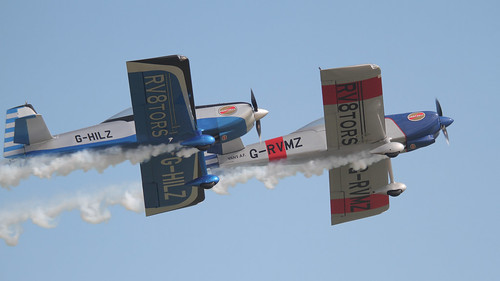
Only five minutes pass before the next display begins: two RV8 planes trailing plumes of white smoke. After performing a sequence of close-formation loops and rolls, the two aircraft break to opposite sides of the bay and then fly straight at each other, appearing to avoid collision by a hair's-breadth. It’s a tried and tested manoeuvre, guaranteed to draw a collective “Oooh!” from the crowd. It’s also perhaps the one manoeuvre where the implicit threatens to become explicit, highlighting the unspoken subtext that underlies every high-speed form of entertainment, from air-shows to Formula 1. No one wants anything to go wrong – of course they don’t – but the potential for disaster is ever-present, adding a tangible air of frisson to the occasion.

RV8 Display

The photographer tenses, tracking one of the planes as it flies right to left. In the back of his mind he wonders what he’d do if something did go wrong and one or both of the planes ended up in the sea – or worse. Would he keep shooting? What if he captured something truly harrowing? Would he sell the photos to the highest bidder? Would he sell them to the Daily Mail? Would he sell them to the Sun? He likes to think he wouldn’t, but of course, until we’re in that situation none of us know for sure. Not really.

The RV8 planes perform a variation on the loop-the-loop manoeuvre, using their smoke trails to draw a huge heart in the sky. Then they fly across the bay, left to right, one after the other, and the display is over. The wind is noticeably stronger now; the third scheduled display will not go ahead. The smoke trails disperse quickly and so do the spectators, kids nagging their parents for ice-cream. Already long queues are forming outside the two main parlours, Morelli’s and Chiappini’s. The tannoy crackles but – not for the first time that afternoon – the speaker’s words are inaudible to a large section of the crowd.

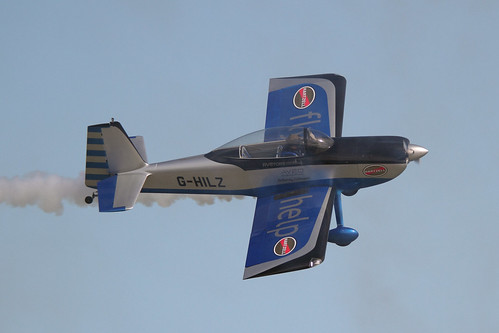
The photographer retreats to the shade of Ballard’s Lounge and orders a cold San Miguel. He sits by the window and reviews his photos. None of them are remarkable as aircraft photography goes, but there are enough keepers to meet his own modest expectations. He finds one from the end of the display, almost the last photo he took: it’s a close-up of one of the RV8 planes, smartly painted in shades of silver, blue and black, designation G-HILZ.

RV8TOR

He enlarges the photo on the LCD, zooming in on the cockpit. The pilot’s left hand is raised to acknowledge the crowd, but frustratingly – from an aesthetic point of view – his face is not visible. Perhaps he’s concentrating on the smoke trail left by his colleague moments earlier. Perhaps he’s already thinking ahead to the display he’ll be attending at the weekend.

The pilot’s name is Andy Hill. In three days’ time he will take to the skies above Shoreham in a very different kind of plane – a Hawker Hunter jet. I don’t need to describe what happened next; we’ve all seen the pictures and the footage, and sometimes, when the images linger in our mind like a bright light that takes forever to fade, we might find ourselves thinking about the dividing line between life and death, and wondering if we’ve seen too much.

Monday, 1 September 2014

Broadstairs Water Gala 2014


Once again Broadstairs was blessed with sunshine and blue skies for the 2014 Water Gala, although the crowds seemed slightly down on the previous year. The good visibility and light breeze meant that all three planned air displays could go ahead, beginning with the Extra 300, which looked like it was pulling quite a few g's as it looped and soared:


This was followed by the Trig Aerobatic display team with their precision formation flying:


And finally, what I - and just about every other photographer there - had really come to see, the Grace Spitfire:


Pictures only tell half the story. It was a real privilege to hear that Merlin engine roaring over Viking Bay.

The Gala was rounded off by a fireworks display in the evening. It seems mandatory these days for every display to be accompanied by a hovering drone shooting footage from a bird's-eye perspective (not that any bird would fly near a firework). Was it wrong of me to feel disappointed that the drone survived the display without getting hit? The organisers must have been in a hurry to get home, as the last thirty or so fireworks all seemed to go off at once, much to the delight of the watching crowds. Intentional or not, it provided a suitably window-rattling finale to what had been a highly entertaining day.

See also:
More of my photos of the 2014 Water Gala
Broadstairs Water Gala (official page)
Trig Aerobatic Team
The Grace Spitfire ML407


Monday, 26 August 2013

Broadstairs Water Gala 2013

A packed Viking Bay played host to Broadstairs' annual Water Gala last week, featuring jet skis and flyboarding, and a visit from the Ramsgate lifeboat. A three-part air display was also scheduled, and perfect conditions meant that all three planes could take to the skies as planned.

First up was the Catalina seaplane G-PBYA, visiting Broadstairs on day one of its Circuit of Britain challenge:

Catalina Seaplane (detail)

This 70-year-old plane is the only airworthy Catalina in the UK, and it made several passes of the bay before continuing on its tour, making sure everyone got to see it from all sides.


The Catalina was followed by the Yak 50 G-CBPM, one of the Aerostars display team that performed here last year:

Yak-50 G-CBPM

Finally, Manston's very own trusty old Boeing Stearman biplane, a plane I've seen several times over the years, but never had the opportunity to photograph against blue skies until now:

Boeing Stearman Biplane

The festivities were rounded off by a fireworks display in the evening. I left my camera at home for that, figuring I'd already taken quite enough photos for one day.

See also:
More of my photos of the Water Gala
Broadstairs Water Gala (official page)
Project Hawker 2013