Showing posts with label nature. Show all posts

Saturday, 28 October 2017

Shooting with the Canon 80D

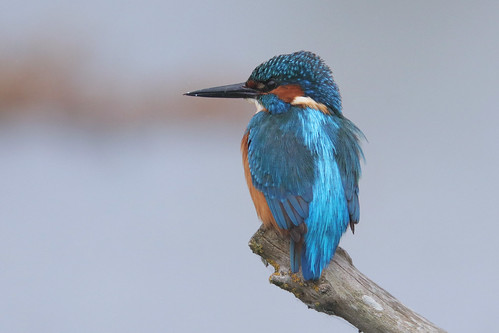
Kingfisher (Alcedo atthis)
Canon 80D & Tele Vue 60 refractor, 1/1250 sec, ISO 640

I tend to steer clear of technical write-ups on this blog as the Internet is already stuffed with photographers telling you all about what their camera can do rather than what they've actually done with it. However, given that the bulk of the traffic to my Flickr pages this year has been driven by people specifically looking for photos taken with the Canon 80D, I thought I'd share my impressions after several months of shooting with it. Please bear in mind that this is all very subjective and I can only compare the 80D against other Canon DSLRs I've used (namely the 350D, 40D and the 7D Mark I).

Noise-handling is significantly improved over the 7D Mk I. Tastes vary of course (I don't mind a little grain as long it doesn't look too obviously "digital" - and I actually prefer it to the over-aggressive noise reduction that some photographers insist on), but I find the 80D gives exceptionally clean images up to ISO 400, and stays workably clean all the way up to ISO 3200. The image below was taken in very gloomy conditions at ISO 3200, but I was still able to get a good 12x8 print out of it.
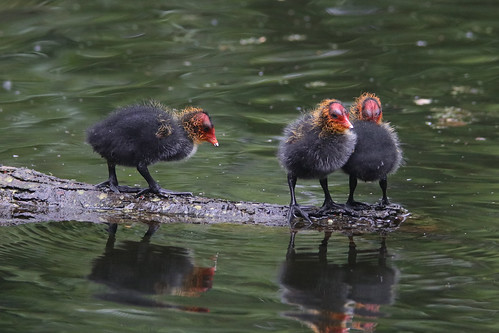
Coot Chicks
Canon 80D & Tele Vue 60 refractor, 1/1250 sec, ISO 3200

From ISO 4000 the noise gets progressively more obtrusive, but still manageable (as demonstrated in this shot of a black cat, taken in poor light at ISO 5000 and downscaled to 12x8). Even at the highest ISOs the 80D's large pixel count means that you should be able to get an acceptable 6x4 print provided you don't have to crop too much.

The 80D's default colour setting seems slightly desaturated compared to previous models, but this can be easily fine-tuned in-camera or in post. The "Peacock Butterfly" test certainly produces reds that look closer to nature than the over-saturated reds of older Canon DSLRs.

I use manual focus for most of my wildlife photography so I can't really contribute anything to the 80D vs. 7D Mk II autofocus debate, but on the occasions I've used the touchscreen focus I've found it to be fast, responsive and very intuitive to use. If, like me, you plan to use your camera for astrophotography now and then, you might consider the 80D's articulated touchscreen to be a more valuable feature than the 7D Mark II's advanced tracking.

Birds-in-flight are always going to be a challenge using manual focus, but so far I've found that my hit-rate is better than with any previous Canon DSLR. Would autofocus have successfully tracked this tern or would it have zeroed in on the coots in the background?
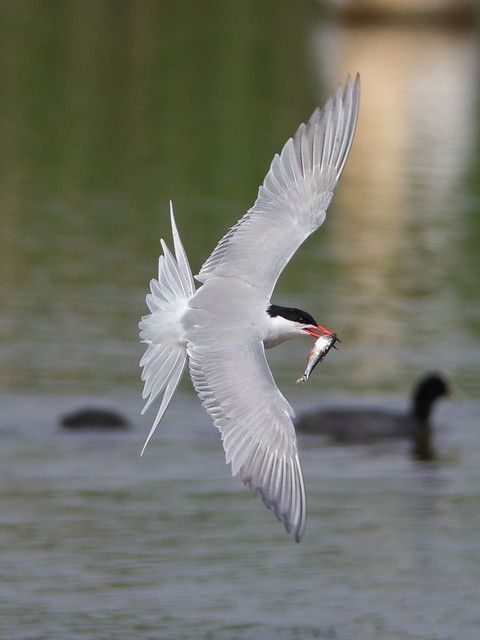
Tern (with fish)
Canon 80D & Tele Vue 60 refractor, 1/1600 sec, ISO 400

Much has been made of the 80D's improved dynamic range at lower ISOs, and you'll find plenty of examples online where photos have been deliberately underexposed by an extreme number of stops and then fixed in Lightroom/Photoshop to demonstrate the camera's capacity for shadow recovery. In real-world terms you'd have to be doing something drastically wrong to underexpose a photo by that much without realising (and the metering is almost always spot-on - more so than any other camera I've used), but the improved DR does give you scope to be more adventurous in your post-processing, especially when trying to emphasise a particular mood. See this black-and-white shot of Whitby Abbey below for an example (move your cursor across the image to toggle the before-and-after):

Canon 80D + EF50mm f/1.8; 1/250 sec, f/8.0, ISO 125

I'm struggling to think of anything I don't like about the 80D: I miss the mini-thumbstick from the 40D and the 7D, but the touchscreen makes up for this. Overall the Canon 80D is a user-friendly and feature-packed camera (including settings for time-lapse, multi-exposure, minimum shutter speed, flicker detection, and so on) that does everything I would want from a DSLR.


See also:
More of my photos taken with the Canon 80D


Monday, 8 May 2017

Answer: "It's a Tele Vue."

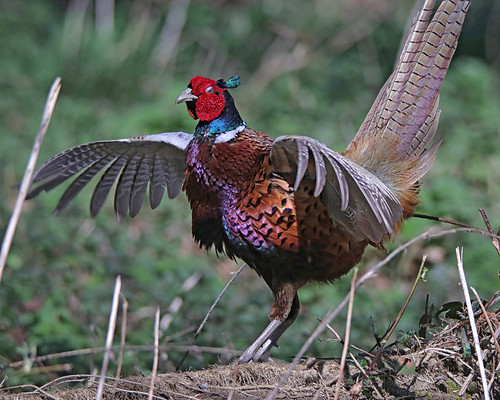
Pheasant (Phasianus colchicus)

The question being, typically: "What's that on the end of your camera?"

As the name of this blog suggests, I do most of my photography with a telescope - a Tele Vue-60 refractor to be precise. What it lacks in autofocus and aperture control it more than makes up for in sharpness and colour correction. It's compact and portable and it doesn't need to be stopped down to hit the sharpness sweet spot. Recently Tele Vue embraced the world of social media and - as part of their ongoing 40th anniversary celebration - they asked if they could feature me on their new blog, in particular why I chose the TV60 and why I've stuck with it over the years. You can read the resulting post here:

http://televue.com/notamnomen/2017/05/02/tele-vue-is-for-the-birds/#.WRC_XNQrL4Y

Three scopes in one: astro-scope, spotting scope and telephoto lens

Astronomers of course need no introduction to Tele Vue, but for those who don't know, they're a Chester, New York-based company founded in 1977 by Al Nagler. Prior to that Al designed lunar landing simulators for the Apollo missions, using his knowledge of optics to create realistic wide-field vistas to aid the astronauts' training.

Tele Vue started out making lenses for large projection-screen televisions, but they've since become renowned for their high-quality eyepieces and telescopes. If you ever get the chance to look through one of Tele Vue's wide-field eyepieces, I highly recommend it. They call it the "spacewalk" experience and with good reason: if, like me, you started out in astronomy squinting through a cheap and cheerful 0.965" eyepiece, the difference is startling. When looking through a Nagler it's as if the eyepiece "gets out of the way", leaving you immersed in the stars (or suspended above the moon if lunar observing is your thing). And if the 82-degree apparent field-of-view of a Nagler isn't enough for you, they also do an Ethos range, which goes up to a whopping 100 degrees.

In the interests of fairness and transparency I should point out that:

a) Other telescopes and eyepieces are available
b) I was not offered any incentive by Tele Vue (financial or otherwise) to contribute to their blog or write this post. I'm just a proud TV-60 owner and I wouldn't dream of parting with it.

See also:
Tele Vue home page
My TV-60 photos on Flickr

Sunday, 8 January 2017

A few thoughts on Google's Nik Collection

Back in March, Google made the entire Nik Collection photo-editing suite available as a free download. Despite my initial scepticism (and wariness of filters that claim to replicate the "look" of film), I have to admit - now that I've been using it for a few months - it is actually really good and serves as a helpful complement to Photoshop. The Control Point technology is particularly useful for carrying out localised enhancements, saving a lot of time compared to manually creating masks.

Selective sharpening using colour range masking

Of course, no amount of software wizardry can turn a bad photo into a good photo, but with a little care you can get some interesting results, as shown below. (Note: my photo-editing steps are usually a lot more subtle than this. I provide these photos as examples because it's easier to see the difference.)

Move your mouse across the images to see them as they appeared before processing. Most of these results were achieved using Color Efex Pro, but the first image (the helicopter over the house) was enhanced using Silver Efex Pro to create a High Dynamic black-and-white luminosity layer.

Helicopter at North Foreland, April 2016 

Stodmarsh Hobby, May 2016

Bright Wake on a Dark Sea, November 2016

Common Tern, May 2016

Stodmarsh NNR, June 2016

The complete Google Nik Collection suite is available at:
https://www.google.com/nikcollection/
It works best as a Photoshop plugin (under the Filter menu), but you can also run each application as a standalone program if you create short-cuts to the individual .exe files.


Friday, 17 June 2016

Birds of East Kent: Peregrine Falcon

Latest in an occasional series of posts discussing the different birds that can be found in East Kent.

Beady Eye

The peregrine makes its presence felt long before you see it: a dead pigeon lies on its back on a windswept beach, its wings spread and its breastbone stripped of meat; a golfer notices your camera and calls out to tell you that you "just missed a peregrine"; fulmars cackle their disapproval as a crossbow-shaped shadow glides over their nests and across the cliff-face. You walk and you walk until finally you see a hunched, powerful-looking bird poised on an outcrop of flint. On the beach below a man is walking his dog, blissfully unaware of the apex predator right above his head, but when you peer through the lens you see that the peregrine is looking at you, not the dog or its owner. A peregrine sees everything and misses nothing. It spotted you the moment you stepped into its field of view, and now that it knows you're looking at it, the peregrine alone will decide how close you will be allowed to get.


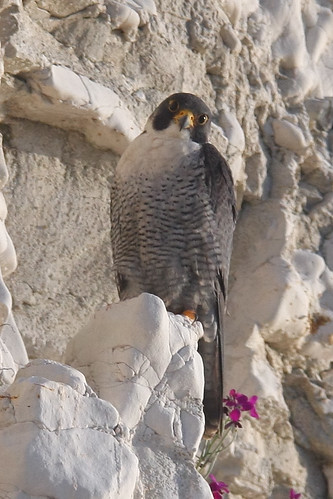
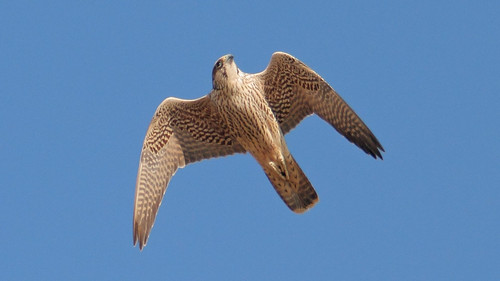
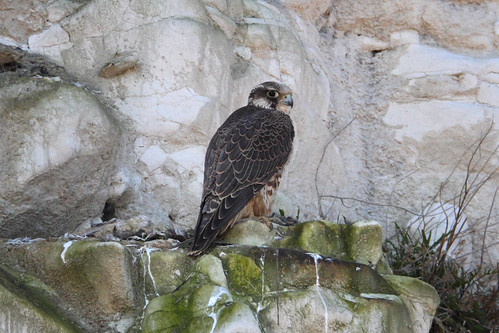
Peregrine Falcon


Thanks to works like J.A. Baker's The Peregrine, the eponymous falcon enjoys a near-mythical status unmatched perhaps by any other British bird. Baker's account (I can't really call it a memoir since the author effectively excises himself from the narrative) condenses a decade's worth of observations into a single year, a structural choice which also has the effect of condensing his patient study of the peregrine into a singularly obsessive quest. Reading it, you're left in little doubt that Baker - short-sighted and afflicted with a rare and rather unpleasant form of arthritis (I speak from experience on the latter) - wishes he were a peregrine himself:

Free! You cannot know what freedom means till you have seen a peregrine loosed into the warm spring sky to roam at will through all the far provinces of light. Along the escarpments of the river air he rose with martial motion. Like a dolphin in green seas, like an otter in the startled water, he poured through deep lagoons of sky up to the high white reefs of cirrus.

Peregrine Falcon (Falco peregrinus)

Like dark chocolate, Baker's dense, synaesthetic prose is probably best savoured in small chunks. And yet, for all the linguistic fireworks on display, the narrative is tinged with a wistful, elegiac tone. Baker had good reason to be pessimistic; at the time he wrote his book the peregrine was in serious decline - its numbers ravaged by persecution and pesticides.

But for once, the story has a happy postscript (albeit one that Baker himself didn't live to see). Peregrine Falcons have enjoyed a spectacular resurgence and you can now see them right across the country, repopulating urban environments as well as their more traditional hunting grounds. If you live near a cathedral or a high chalk cliff, there's a good chance you also live near a peregrine. And when you see one for yourself you'll understand why these majestic birds inspire such reverential prose.

See also:
More of my Peregrine photos on Flickr
Keith Ross's YouTube channel (includes a series of short films on the Ramsgate Peregrines)
Peregrine Falcon (RSPB)
Peregrine Falcon (Birdforum)
Peregrine Falcon (Birdguides)

Sunday, 11 October 2015

Two Days in the Camargue

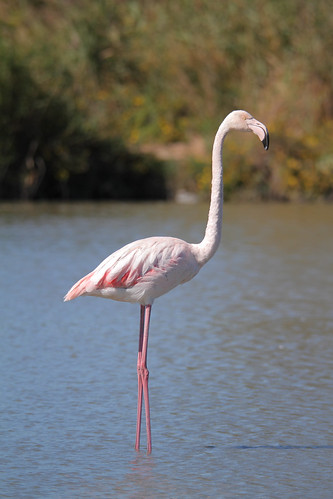
Portrait of a Flamingo

As much as I love writing, if there was one thing I dreaded at school it was having to complete the "What I did on my holiday" essay. So, rather than bore you with every detail, I'm going to boil the trip down to its essentials (i.e. what I anticipate visitors to this blog would want to know about) and let the pictures do most of the talking. If you have any questions not covered by the ones given below then please use the comments section and I will do my best to answer them - though bear in mind that I'm more of a "photographer who happens to shoot birds" than a "birder who happens to have a camera". The object of the trip was not to track down the rarest species, but to have a good time and hopefully get some decent photos along the way. It's also worth noting that the Camargue is B-I-G; two days really only allows time for a whistle-stop tour, but you could easily spend a week there and still only scratch the surface.

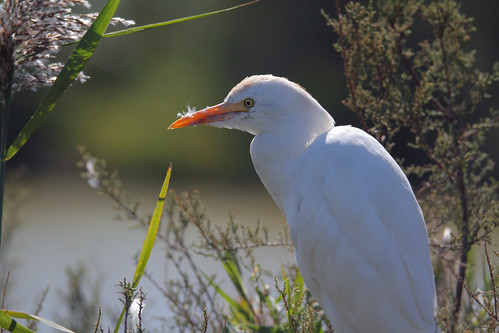
Cattle Egret (Bubulcus ibis)

Quick question: Was it worth it?
Quick answer: Absolutely, yes!

Did you have a guidebook to the region?
Most of the guidebooks I could find for sale are a few years out of date, but there is a free booklet online which proved to be extremely useful. It contains maps, species lists, and much more. The English-language version is available via this link:

Where to watch birds in the Camargue Regional Nature Park - France (PDF)

Using Arles as a base, we visited four of the eleven sites listed, as well as the very pretty - and very touristy - town of Saintes-Maries-de-la-Mer.

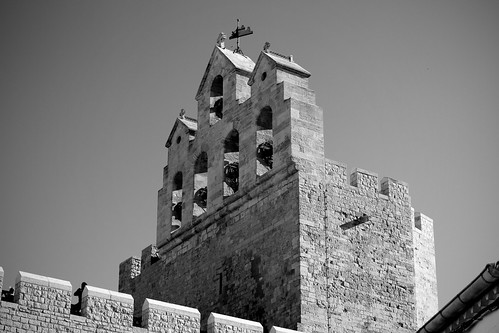
Fortified Church

So what's the big deal about the mistral?
The mistral is a wind, but it's not like any wind you'll experience in England. When it decides to blow it will do so all day - at the same speed and in the same direction - and it won't ease off until the sun goes down. The Camargue is mostly flat, so there aren't many places you can shelter from it. A light, windproof jacket is recommended.

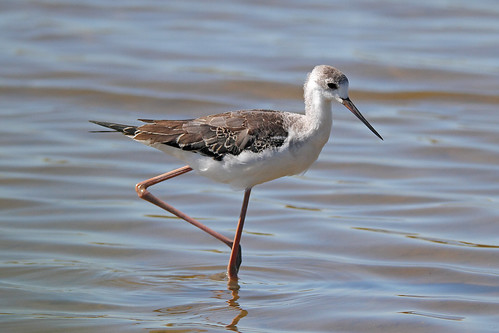
Black-winged Stilt (Himantopus himantopus)

What else should I take?
Sun cream and insect repellent. Make sure you carry plenty of drinking water too; even in September the temperatures can reach the high twenties.

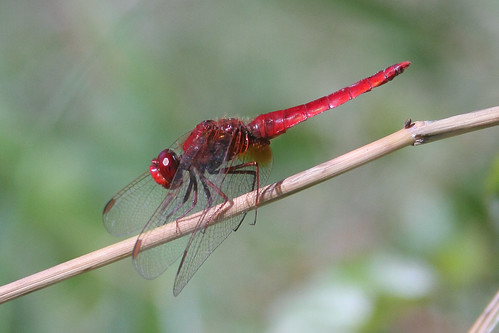
Red Dragon

Best place to go to photograph birds?
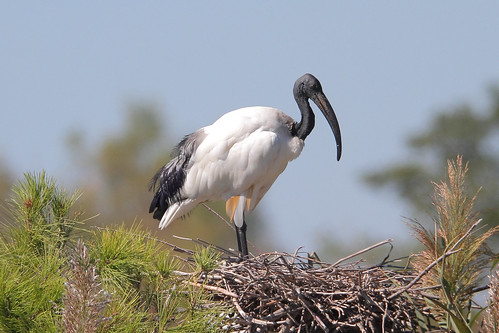
There may well be other reserves (that we didn't have time to visit) within the Camargue that provide a similar experience, but if you want to see the key species of the region at close quarters and get photos "in the bank", so to speak, then the Pont de Gau bird sanctuary is the place to go. As well as the famous flamingos, we saw, among other things, grey herons, little egrets, cattle egrets, spotted redshanks, black-tailed godwits, avocets, black-winged stilts, spoonbills, and a sacred ibis (below). Admittedly, with the exception of the flamingos and the ibis, these are all species you can see in England with increasing regularity, but probably not all in one place, and certainly not within a few feet of the viewing hide.

Sacred Ibis (Threskiornis aethiopicus)

Recommended eating?
All three of the restaurants we visited in Arles were good, but the Restaurant Le Plaza La Pailotte was exceptional. I had the duck breast (don't tell the wildfowl!) and it was, quite simply, one of the finest meals I've ever had. (And no, I didn't take a photo of my food.)

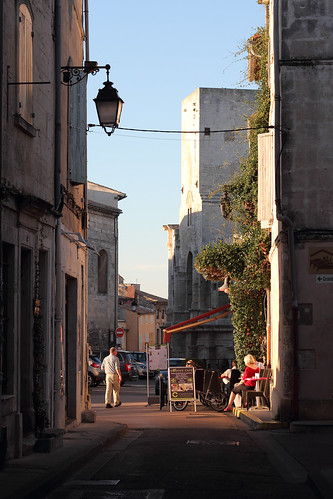
Rue Porte de Laure

Other highlights that you can't convey in a photograph?
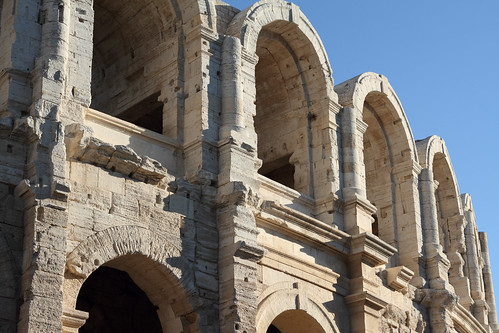
Bats flying above the Rhone at sunset, the strangely soothing background noise of insects (presumably crickets) chirping at night, stumbling upon a bizarre tractor parade in Arles on Saturday evening, still being able to feel the lingering warmth of the sun and the force of the mistral on my face long after the sun had gone down, the sheer physical and historical presence of the Arles Roman Amphitheatre (below), waking up early to see Sirius shining higher in the sky than I've ever seen it before, and of course a welcome reminder that you can't beat a genuine French baguette.

Arles Amphitheatre

Anything else worth knowing?
The SatNav on the rental car was, unsurprisingly, in French. After some fumbling we found the option screen to change the language. English was not one of the available languages. Fortunately, if you know your gauche from your droite, you should be able to cope.

Finally, special thanks must go to my friends Mark, for his organisational and driving skills, and to Tony, for his near-supernatural ability to liken almost any situation to an episode of the old TV show Only Fools and Horses.

See more of my photos from the Camargue and Arles on Flickr.


Monday, 2 March 2015

40D to 7D

Yes I'm aware that I'm half a decade behind the curve, but the trusty Canon 40D had served me so well over the years that I hadn't felt the need to upgrade. (Before that, I'd used a 350D / Rebel XT.) However, in recent months I'd noticed that my photos were starting to look a bit "samey" and I wondered if I was reaching the limits of what I could do with the 40D.

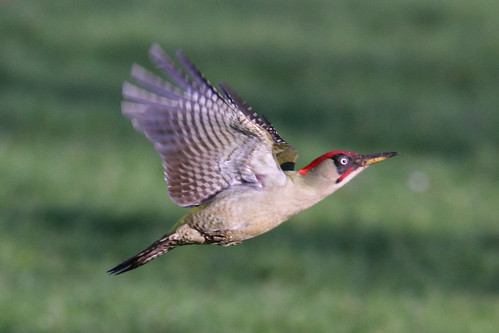
Green Woodpecker in Flight
Canon 7D & Tele Vue-60; 1/1600 sec, ISO 800

Enter the 7D Mk I. Enough's been written about this camera online and in print already, so I'll let the pictures do most of the talking and add a few observations along the way.

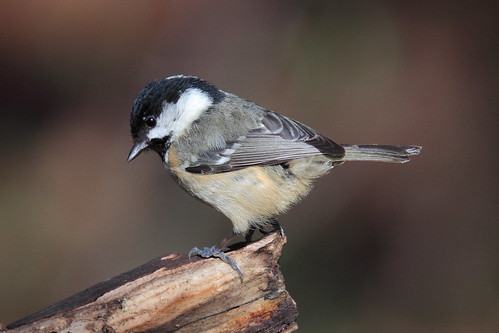
Coal Tit (Periparus ater)
Canon 7D & Tele Vue-60; 1/1250 sec, ISO 640

10 to 18 Megapixels: I was worried that all those extra pixels might magnify the shortcomings of my style of shooting (mostly hand-held, with a manual-focus telescope) rather than improve the quality of my photos, but it turns out the 7D is an excellent match for the Tele Vue-60 (my wildlife lens of choice). I now have much more leeway to crop and re-frame the subject while still being able to produce a decent-sized print if necessary.

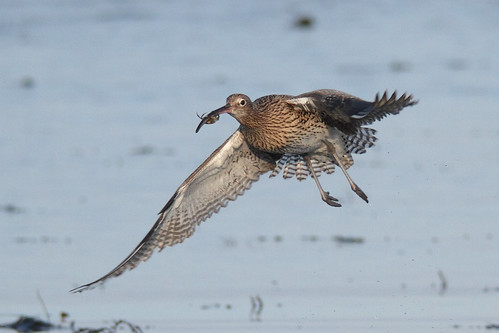
Curlew (with crab)
Canon 7D & Tele Vue-60; 1/2000 sec, ISO 800

Auto ISO: Although this was a feature on the 40D, it never really lived up to its potential. On the 7D it does. Whereas before I used to shoot in Aperture-Priority AE (Av) and let the camera choose the exposure time, I can now shoot in Shutter-Priority AE (Tv), choose a shutter speed appropriate for the subject and the focal length of the TV60 (typically anywhere from 1/1000 sec to 1/2500 sec depending on how much coffee I've drunk that morning), set the Exposure Compensation for the lighting conditions, and let the camera choose the correct ISO.

Moorhen (Gallinula chloropus)
Canon 7D & Tele Vue-60; 1/1600 sec, ISO 2000

Noise: From what I've seen on Internet forums, this seems to be the biggest bone of contention about the 7D, with some users getting very clean images all the way up to ISO 3200, and others claiming it's unusable above ISO 800! (It's worth noting here that because of the way a Bayer filter works, the camera captures twice as much information in the green channel as it does in the other two channels, which may explain why photos of birds against blurred green backgrounds seem to show less noise.) Personally, I don't mind a bit of noise as long as it isn't too obtrusive, and I actually prefer a bit of grain over the plasticky effect you see in some over-processed photos. With regards to the 7D, I find that the RAW conversion needs a little more fine-tuning in Digital Photo Professional than I'm used to, but with care I can get an image at ISO 3200 which is no noisier than an image taken at ISO 1600 with the 40D. This, when you factor in the higher resolution of the 7D, is a considerable improvement. Obviously, I'm still getting used to the camera as well adapting my methods of post-processing, but my impressions so far are overwhelmingly positive. Also, it seems to me that the 7D sometimes errs slightly on the side of over-exposure, which ironically can make for a cleaner final photo.

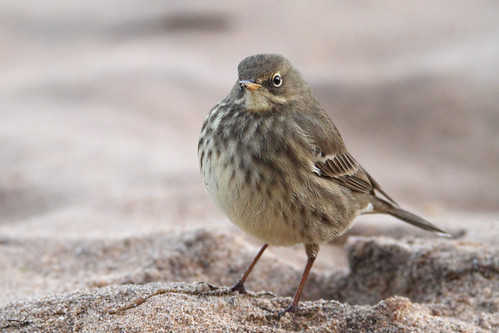
Rock Pipit (Anthus petrosus)
Canon 7D & Tele Vue-60; 1/1600 sec, ISO 3200

Are my photos significantly better? The Flickr community seems to think so. I know that comments and faves aren't always a reliable measure of quality, but my views have shot up since I started posting photos taken with the 7D, with at least four images hitting the giddy heights of Explore. Or is all that traffic a side-effect of people searching for photos taken with the 7D Mark II?

Nuthatch (Sitta europaea)
Canon 7D & Tele Vue-60; 1/1250 sec, ISO 1250

Decide for yourself: see more of my photos taken with the Canon 7D.

Friday, 31 May 2013

Have I Got Newts For You

This time last year I'd never knowingly seen a newt outside of a book or a TV programme. Then, in a pond not far from where I work, I spotted several of these:

Great Crested Newt larva

This, I subsequently found out, is the larval form of the Great Crested Newt, the largest - and most endangered - of the three species of newt native to Britain. With its rough, granular skin, scythe-like tail and impressive jagged crest, the adult male Great Crested Newt is the closest you'll come to seeing a dragon in the English countryside, so - as you can imagine - I was rather keen to get a photo of one.

Like a lot of creatures, Great Crested Newts look at their best during the breeding season (i.e. now), but trying to photograph them is easier said than done. I quickly found out that they rarely come up to the surface, and when they do they typically dive straight back down again before you can get the camera anywhere near them. In the meantime, I had to console myself with getting pictures of the smaller Smooth (Common) Newt:

Smooth Newt

...and the equally diminutive Palmate Newt, with its distinctive webbed hind feet and tail filament:

Palmate Newt (Lissotriton helveticus)

But still no photos of a Great Crested Newt.

Then, just when it seemed that the pond would be covered with lily-pads before I even got so much as a single shot, my Great Crested Nemeses finally decided to cooperate:

Great Crested Newt (Triturus cristatus)

Okay, so they're not the cleanest photos I've ever taken, but shooting subjects in a pond (as opposed to a brightly-lit aquarium) is never easy at the best of times, and you can only do your best with what you've got. If you're trying it yourself I recommend a fast, close-focusing lens in the 100 - 300 mm range ... and a great deal of patience.

P.S. I apologise for the terrible pun headlining this post, but it was either that or the even more lame "Goodness Gracious, Great Crested Newts!"


See also:
More of my newt photos on Flickr
Great Crested Newt Conservation Handbook (froglife.org)


Thursday, 19 April 2012

Introduction

Kingfisher, Grove Ferry

First off, I don't claim to be an expert on birds or photography, so if I confuse a silent Chiffchaff for a silent Willow Warbler (or vice versa), or get into a muddle over crop factors then please let me know and I will endeavour to correct my mistake. (Constructive comments are always welcome.) However, I do like to think I've learned a few tricks over the last few years, so perhaps you'll find some of these posts interesting and maybe even useful on occasion.

I've been reluctant to start a blog of this nature before now because a) I've never been one for keeping a diary, and b) having maintained a Flickr page for several years I've always been of the opinion that a good photo should speak for itself without any distracting words. However, I'm often asked how I got a particular shot, how I processed it, or indeed what that thing is on the end of my camera, so hopefully this blog will go some way towards answering those questions.

As there are already a number of excellent websites and photography blogs covering the wildlife in and around East Kent (some of which I've linked to on the right), I don't intend to simply replicate what's already out there. So, as well as describing what I've seen in a given week, I'll also be writing about how I take and process my bird photos, as well as occasionally venturing beyond the Earth and into the realm of astrophotography.

Lunar Apennines

The common thread linking these strands is that almost all of the photos you'll see on this blog were taken with a Canon DSLR mounted at the prime focus of a telescope; the birds and insects with a Tele Vue-60 apochromatic refractor (focal length approximately 400mm), and the moon and the planets with a Vixen SP-102 achromatic refractor (focal length 1000mm and - with a Powermate - 2500mm). There are pros and cons (and misconceptions) to using a telescope instead of a dedicated camera lens - some of which I'll be talking about in future posts - but I have to admit there is something quite appealing in being "that guy who shoots with a telescope" as opposed to being just another photographer with a big white lens.

Plus, telekilnesis has a nice ring to it, don't you think?